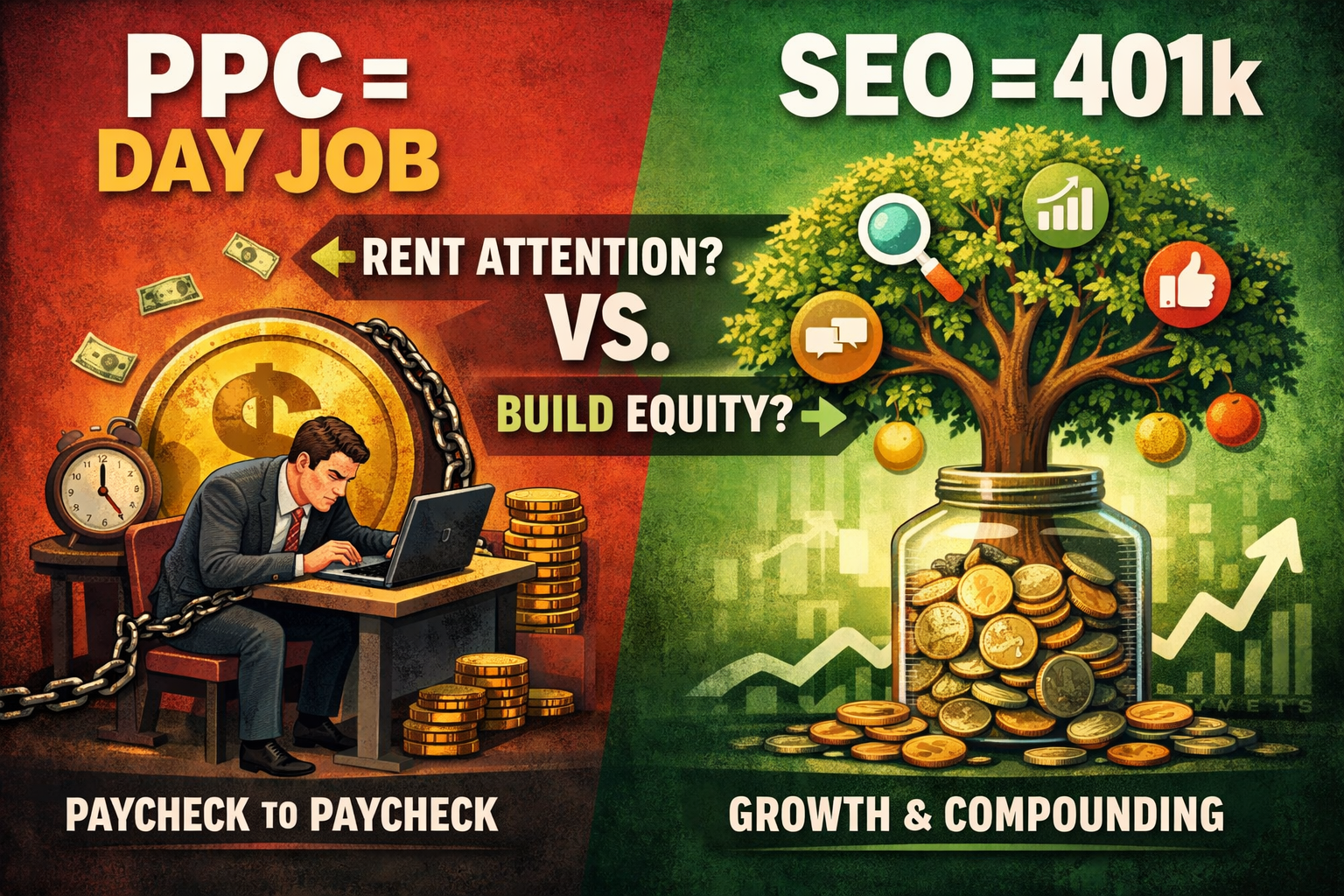
Are you renting attention… or buying equity?
Most companies don’t realize they’ve already made a strategic decision about their growth model.
Not consciously. But structurally.
They treat SEO like a slot machine—pull the lever, expect traffic tomorrow. And they treat PPC like an asset—something they can rely on forever.
That’s backwards.
Because in reality, your marketing strategy isn’t just about traffic.
It’s about wealth-building mechanics.
- One channel behaves like a day job.
- The other behaves like a retirement account.
If you don’t understand which is which, you’ll stay busy… but never actually build anything that lasts.
The PPC Day Job
Instant Gratification & Golden Handcuffs
PPC is simple. That’s why it’s seductive.
You put money in → you get clicks out.
It’s a clean, direct exchange:
Pay an hour, get an hour.
Why PPC Works (And Why Everyone Loves It)
Let’s be fair. PPC earns its place:
- Immediate feedback: You can validate an offer in days, not months.
- Control: You choose the keywords, budget, targeting, timing.
- Predictability: Scale up spend → scale up traffic (in theory).
For a founder under pressure to “show results,” this is oxygen.
But here’s the uncomfortable truth.
The Trap: You Own Nothing
PPC is not an asset. It’s a lease.
The moment you stop paying:
- Traffic drops to zero
- Leads disappear
- Growth stalls instantly
There’s no residual value. No carryover. No compounding.
Worse, you’re not just renting attention—you’re bidding for it in a competitive market.
Which means:
- CPCs rise over time
- Competitors enter the auction
- Margins get squeezed
You end up in a situation where:
You’re running faster just to stay in the same place.
That’s the “golden handcuffs” of PPC.
It works. It scales.
But it quietly locks you into a system where growth = more spending.
The SEO 401k
The Power of Compound Interest
SEO operates on a completely different economic model.
You’re not buying traffic.
You’re building assets that produce traffic.
Think of it like a 401k:
- You invest consistently
- You don’t see immediate returns
- But over time… it compounds
The Mechanism: Build Once, Pay Dividends Forever
Every high-quality piece of content, every backlink, every technical improvement:
- Increases your domain authority
- Improves your ranking potential
- Lowers your long-term acquisition cost
Unlike PPC, where each click is purchased individually, SEO builds a system where:
One investment can generate thousands of clicks over time.
The Real Advantage: Declining CAC
Here’s where it gets strategic.
With PPC:
- Your CAC is tied to market prices (which usually rise)
With SEO:
- Your CAC decreases over time as your content continues to perform
That’s compounding.
Not just in traffic—but in efficiency.
The Pain No One Talks About: The Sandbox
Let’s be honest.
SEO is hard to commit to because it violates modern expectations.
- It’s slow at the beginning
- Results lag behind effort
- There’s uncertainty early on
This is the “sandbox period”—where you’re investing but not yet seeing returns.
And most companies quit here.
Not because SEO doesn’t work.
But because they don’t have the patience, system, or strategy to endure the gap between effort and payoff.
A Quick Reality Check
If your SEO strategy is:
- Publishing random blog posts
- Chasing keywords without intent
- Measuring success week-to-week
Then yes—SEO will feel like a gamble.
But when executed as a systematic content strategy, SEO becomes predictable.
This is where most internal teams struggle.
Because compounding only works if:
- Content aligns with buyer intent
- Topics are sequenced strategically
- Authority is built deliberately
Otherwise, you’re just “saving money under the mattress”—not investing it.
Bridging the Gap
This Isn’t SEO vs. PPC. It’s Asset Allocation.
The smartest companies don’t choose between SEO and PPC.
They structure them like a portfolio.
The Right Mental Model
- PPC = Your Day Job
- Pays the bills today
- Provides immediate cash flow
- Gives fast market feedback
- SEO = Your 401k
- Builds long-term equity
- Reduces dependency on paid channels
- Compounds over time
You need both.
But you need them for different reasons.
How They Actually Work Together
This is where most strategies break down.
PPC shouldn’t just be a revenue engine.
It should be a testing ground.
Use PPC to:
- Validate keywords that convert
- Test messaging and offers
- Identify high-intent traffic segments
Then…
Take those insights and invest in SEO:
- Build content around proven queries
- Create assets that rank long-term
- Scale what already works
This flips the risk profile.
Instead of guessing what might rank, you’re:
Investing in what already converts.
That’s how you turn SEO from a “hope channel” into a predictable growth system.
Conclusion: Build the Marketing Portfolio
Most companies don’t have a traffic problem.
They have a portfolio imbalance.
Too much PPC:
- Fast growth
- High dependency
- Zero long-term equity
Too much SEO (without strategy):
- Slow progress
- Uncertain ROI
- Frustration
The goal isn’t to pick a side.
It’s to build a system where:
- Short-term revenue fuels
- Long-term asset creation
The Question You Need to Answer
Be honest:
Are you spending all your time at the day job… or are you building equity?
Because if your growth stops the moment you stop spending, you don’t have a marketing engine.
You have a treadmill.
If You Want a Clear Answer
Most founders and marketing leads don’t need more tactics.
They need clarity:
- Where is your current spend going?
- What’s actually compounding?
- Where are you overpaying for short-term wins?
That’s exactly what we help companies figure out.
We analyze your current mix of PPC and SEO, identify where you’re leaking efficiency, and design a balanced growth portfolio that builds both immediate traction and long-term equity.
If that’s a conversation worth having, we can walk through it together.
Leave a Reply