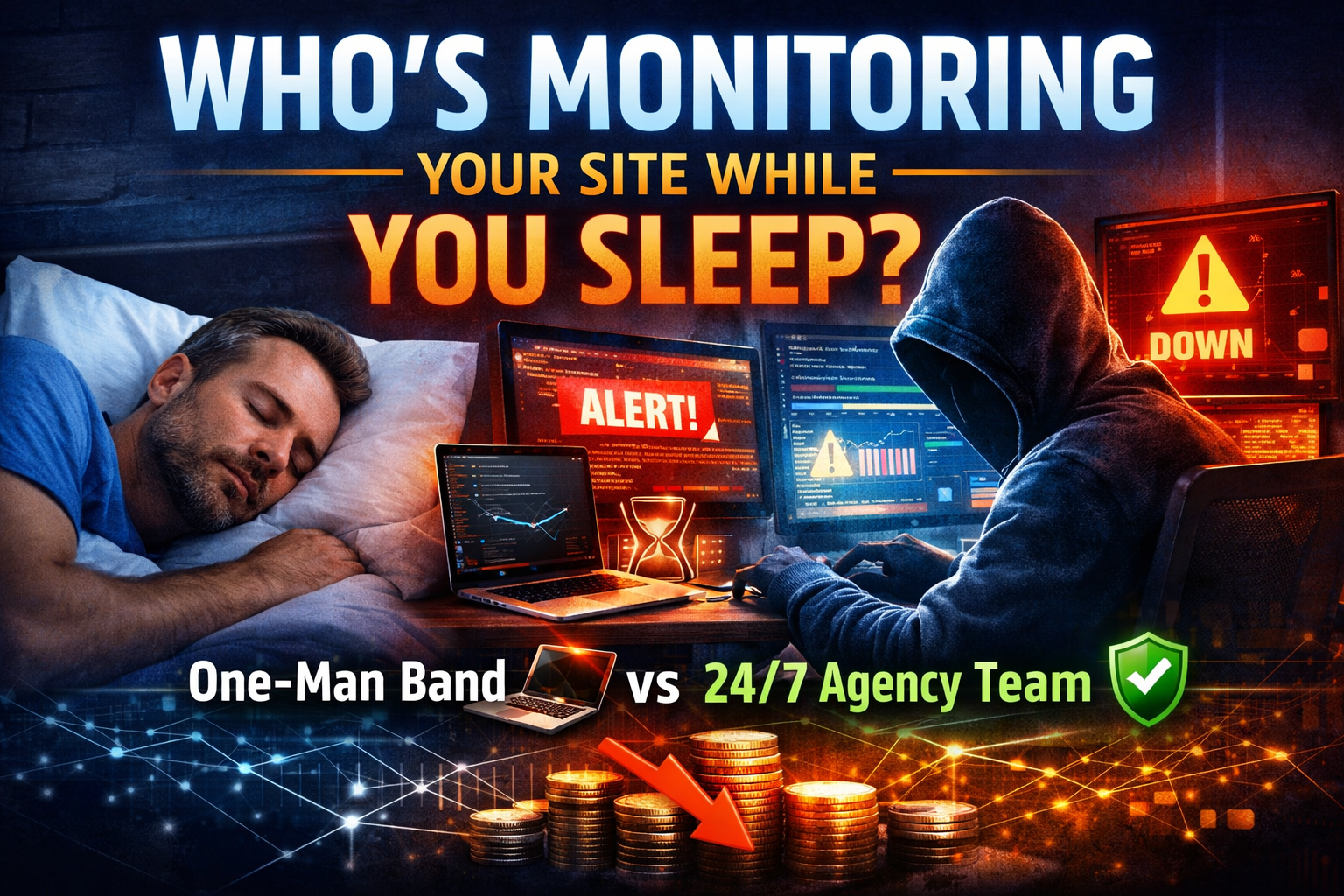
The 3:00 AM Problem Nobody Talks About
At 3:07 AM, your phone starts vibrating on the nightstand.
Not the gentle buzz of a late email.
The aggressive, repeated vibration of something actually wrong.
You reach over, half-awake, eyes squinting against the blue light of the screen.
Two notifications.
Then five.
Then ten.
Your payment processor is sending alerts.
Orders are failing.
Customers are abandoning checkout.
And somewhere—silently—your website stopped working the way it was supposed to.
You open your laptop.
The homepage loads.
But the checkout page?
Broken.
Every failed transaction represents a customer who tried to buy but couldn’t.
In the time it takes to diagnose the issue, restart the plugin, clear the cache, and test the funnel…
$3,200 in revenue disappears.
Not because your marketing failed.
Not because demand disappeared.
But because nobody was watching the machine while you slept.
And that leads to an uncomfortable question most businesses don’t ask until something breaks:
Who monitors your site after hours?
Because if your business earns money 24/7, your infrastructure needs to be monitored 24/7.
The Hidden Risk of the “One-Man-Army” Model
Freelancers are talented. Many are brilliant.
But even the best freelancer faces a structural limitation:
They are still one human being.
Which means:
- They sleep
- They take vacations
- They work with multiple clients
- They can’t watch every system simultaneously
This creates what we call The One-Man-Army Trap.
It looks efficient on paper.
One expert.
One contract.
Lower cost.
But the hidden variable is coverage.
When a single person manages:
- Technical SEO
- WordPress maintenance
- plugin updates
- site monitoring
- performance optimization
- conversion funnels
Something eventually slips through the cracks.
Not because they’re incompetent.
Because the model itself has a human point of failure.
And websites today are too complex to depend on a single set of eyes.
Which is why sophisticated companies quietly shift toward managed SEO and site infrastructure teams instead of isolated freelancers.
Not for talent.
For redundancy.
Systems That Never Sleep
Agencies—when structured correctly—operate very differently.
Instead of a single person responsible for everything, you get layered systems.
Monitoring tools run continuously.
Specialists rotate responsibility.
Alerts escalate automatically.
In other words:
Your site is being watched even when nobody is actively working.
The infrastructure looks something like this:
Industrial-Grade Monitoring Stack
A properly managed digital asset is monitored across multiple vectors:
Security Monitoring
- Continuous vulnerability scanning
- Detection of SQL injection attempts
- WordPress plugin exploit monitoring
- Malware signature detection
Security threats don’t arrive politely during business hours.
Most automated attacks actually happen late at night, when defenses are weakest.
Performance Monitoring
Performance degradation is rarely obvious until revenue drops.
We monitor metrics like:
- TTFB (Time to First Byte) latency
- server response fluctuations
- CDN failures
- database query bottlenecks
- page load time anomalies
Because here’s the uncomfortable truth:
A website doesn’t have to crash to lose money.
If page load speed increases by two seconds, conversion rates can drop by 20–30%.
Performance isn’t a UX issue.
It’s a revenue issue.
Conversion Guardrails
Even technically “healthy” websites can silently stop converting.
We monitor critical revenue pathways like:
- checkout flows
- payment gateway responses
- lead-generation forms
- email capture pipelines
- CRM integrations
Because the most expensive failures are often invisible.
A broken checkout button can cost thousands before anyone notices.
A dead contact form can quietly erase weeks of leads.
Conversion monitoring is where CRO meets technical SEO.
And most businesses don’t have it.
Why Technical SEO Is Really Infrastructure
Many companies think SEO is just:
- keywords
- blog posts
- backlinks
But serious SEO work increasingly overlaps with technical infrastructure management.
Search engines care about:
- site speed
- uptime
- crawl stability
- structured data integrity
- indexability
- server reliability
Which means technical SEO is partly an engineering discipline now.
If Googlebot hits your site during a server slowdown, crawl rates drop.
If plugins create security vulnerabilities, your rankings can tank overnight.
If performance latency spikes, user behavior metrics change.
All of these factors influence organic search visibility.
This is why many companies transition from “content-focused SEO freelancers” to agency-level technical SEO systems.
Not because the freelancer lacks skill.
Because modern SEO is too operationally complex for one person to manage indefinitely.
The Quiet Power of Redundancy
There’s a principle borrowed from aviation:
Every critical system needs a backup.
Commercial aircraft don’t rely on a single hydraulic system.
They have three.
Servers don’t rely on one data center.
They have failover infrastructure.
Yet many businesses trust their entire revenue engine to one human being.
That’s not strategy.
That’s optimism.
Agencies solve this with redundancy and rotation.
Instead of one person responsible for everything, responsibilities are layered:
- Technical SEO specialist
- performance monitoring engineer
- CRO analyst
- security monitoring tools
- automated alert systems
And when one person logs off, another layer is still watching.
Which dramatically reduces the risk of catastrophic blind spots.
A Simple Question Every Business Owner Should Ask
Here’s a useful diagnostic.
Right now—without checking—ask yourself:
If your checkout system stopped working at 2:30 AM…
How long would it take before someone noticed?
Five minutes?
Two hours?
The next morning?
For many companies, the honest answer is 8–12 hours.
Not because they don’t care.
Because nobody was assigned to watch it overnight.
This is often the moment businesses start exploring managed SEO and infrastructure monitoring instead of reactive website maintenance.
Not because something broke.
But because they realize how much risk exists before anything breaks.
The Quiet Audit Most Companies Never Run
One of the most revealing exercises we perform with new clients is a technical stack audit.
Not just SEO.
Not just performance.
The entire monitoring ecosystem.
We ask questions like:
- Are vulnerability scans running daily?
- Is TTFB latency monitored continuously?
- Are conversion funnels tested automatically?
- Are plugin exploits detected in real time?
- Are alert systems configured with escalation layers?
Surprisingly often, the answer is no.
Which means the business is essentially relying on luck and manual checks.
And luck isn’t a strategy when revenue depends on uptime.
The Real Product: Peace of Mind
Most agencies sell services.
SEO campaigns.
Content packages.
Optimization plans.
But the real product—when done correctly—is something much simpler:
certainty.
The certainty that:
- your site is monitored
- your revenue pipelines are protected
- your infrastructure is resilient
- problems are caught early
Not when customers start complaining.
Not when sales drop.
But the moment something deviates from normal behavior.
It’s less like hiring marketing.
And more like buying an insurance policy for your digital assets.
The Final Verdict
If your website generates revenue around the clock…
Then monitoring it only during business hours is a mathematical risk.
Because the internet doesn’t sleep.
Hackers don’t sleep.
Servers don’t sleep.
Traffic doesn’t sleep.
And revenue certainly doesn’t sleep.
Which means the real question isn’t:
“Who built your website?”
The real question is much more important.
Who’s watching it while you sleep?
Leave a Reply