You hit publish.
You refresh analytics.
Nothing.
No impressions. No clicks. Not even a flicker of life.
This is the phase where most marketers quietly panic and bad agencies quietly lie.
“Give it time.”
“It’s indexing.”
“Google is figuring it out.”
All technically true. All completely unhelpful.
Let’s actually walk through what’s happening behind the curtain—step by step—so you understand why the silence exists… and what to do about it.
The Void
Here’s the uncomfortable truth:
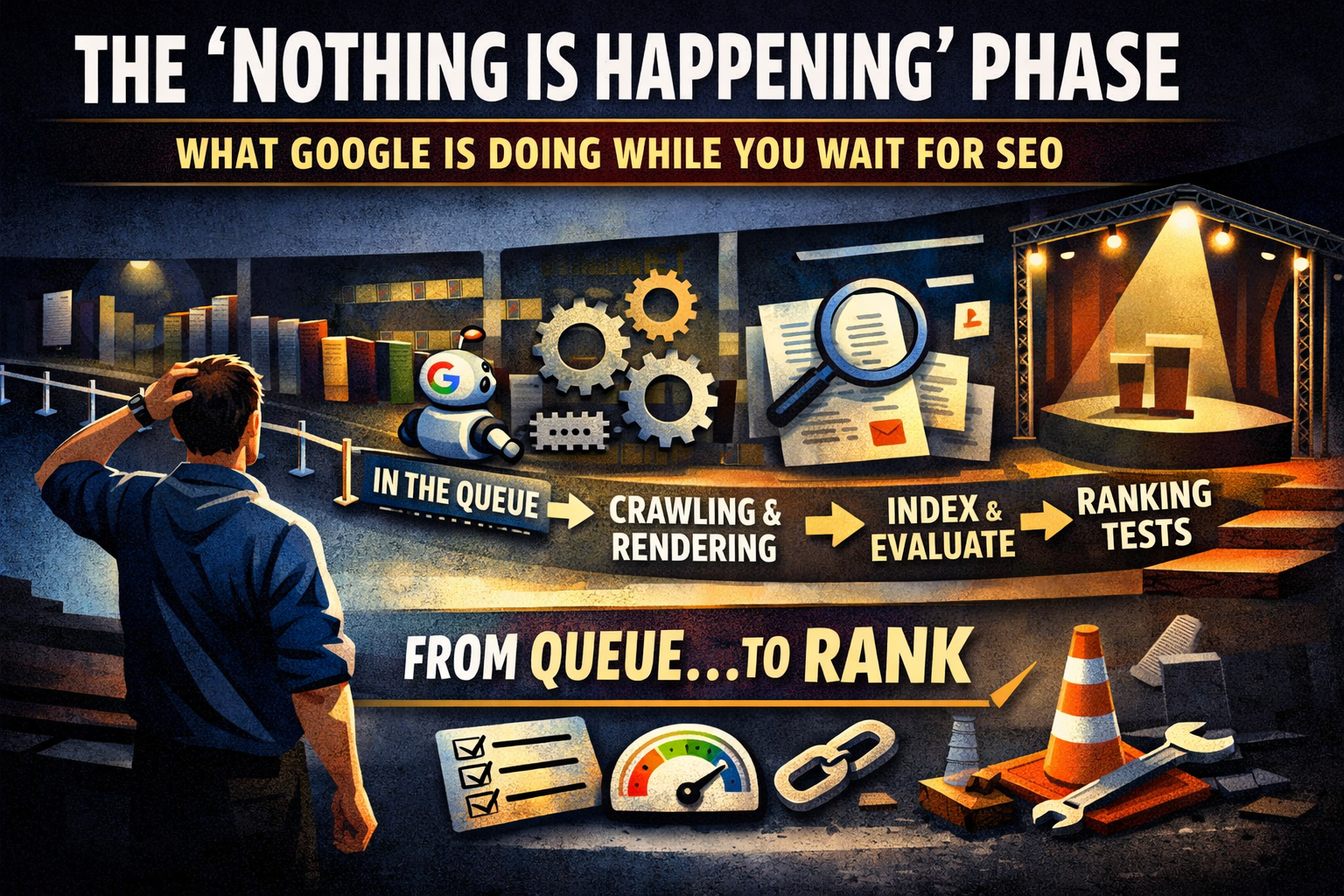
Google is not a live feed. It’s a distributed system processing trillions of documents in waves, queues, and priorities.
When you publish a page, it doesn’t “go live” in Google.
It gets in line.
Think of it like submitting architectural plans to a massive city authority. You don’t walk in and start building. You wait. Your file sits in a stack. It gets picked up when resources allow.
That silence you’re seeing?
It’s not failure.
It’s queue time.
Phase 1: Discovery (Finding the Door)
Before Google can rank your page, it has to know the page exists.
This is discovery—and it’s more primitive than most people think.
Googlebot finds your page through:
- XML sitemaps
- Internal links
- External backlinks
If none of those are strong? Your page is basically a house with no road leading to it.
Where the Delay Happens
This is where crawl budget quietly controls your fate.
Crawl budget is Google’s way of saying:
“How much of our time is your site worth?”
If your site is:
- New
- Low authority
- Thin on content
- Technically messy
…you don’t get priority access.
You wait longer in the queue.
Established sites? They get express lanes.
New sites? You’re in general admission.
What It Feels Like
You’ve published. You’ve submitted your sitemap.
And still—nothing.
That’s not a bug. That’s your site waiting to be noticed.
Phase 2: Crawling & Rendering (Opening the Door)
Let’s say Googlebot finally finds your page.
It doesn’t mean it understands it.
First, it crawls the raw HTML. That’s the easy part.
Then comes the heavy lift: rendering.
This is handled by Google’s Web Rendering Service (WRS), which processes JavaScript, builds the DOM, and tries to see your page the way a user would.
Why This Slows Everything Down
Rendering is expensive.
It’s like the difference between:
- Reading a blueprint (HTML)
- Building the structure to see how it actually works (JavaScript rendering)
Google doesn’t render everything instantly. It queues it.
So you get a weird gap:
- Google has seen your page
- But hasn’t fully understood it yet
The Hidden Risk
If your site relies heavily on JavaScript:
- Key content might not be immediately visible
- Important signals could be delayed
- Or worse—missed
Now you’re not just waiting.
You’re waiting and hoping nothing breaks during interpretation.
Phase 3: Indexing & Quality Evaluation (The Inspection)
Now we get to the part most people misunderstand.
Just because Google crawled your page… doesn’t mean it will index it.
This is the inspection phase.
Internally, Google feeds your page into its indexing system (historically known as Caffeine). Here, your content gets evaluated like it’s under a microscope.
What Google Is Checking
- Duplication: Are you saying something new, or remixing what already exists?
- Content depth: Is this thin, generic, or actually useful?
- Topical signals: Do you demonstrate real understanding?
- E-E-A-T: Experience, Expertise, Authority, Trust
This is where low-effort SEO dies.
Not with a penalty.
With indifference.
Your page simply doesn’t make the cut.
The Brutal Reality
Most pages never make it through this stage.
They exist.
But they’re not indexed.
Which means they’ll never rank.
That’s why “we published 50 articles” often translates to “Google ignored 40 of them.”
Phase 4: Serving & Ranking (The Stage)
Let’s assume you pass inspection.
Now your page is eligible to show up in search results.
But ranking isn’t a fixed position. It’s a constant test.
Google is now asking:
“Does this page deserve to be here… compared to everything else?”
What Happens Next
Your page enters live search environments where it gets tested against:
- Competing pages
- Different queries
- Real user behavior
You might see:
- Sudden impressions spikes
- Rankings jumping from page 5 to page 2
- Then dropping again
This isn’t instability.
It’s experimentation.
The Lag Nobody Talks About
Google doesn’t fully trust new pages.
It probes them.
It tests:
- Do users click?
- Do they stay?
- Do they bounce?
Until those signals stabilize, your rankings will feel… unpredictable.
That’s not failure.
That’s your page auditioning.
The Takeaway: How to Safely Speed It Up
Now that you’ve seen the full pipeline, the goal isn’t to “hack” Google.
It’s to remove friction at every stage.
Here’s what actually moves the needle:
1. Stop Resubmitting URLs Obsessively
This is one of the most common mistakes.
Every time you aggressively resubmit or “request indexing,” you risk:
- Resetting your position in the processing queue
- Sending low-quality signals if done excessively
More pushing ≠ faster results.
Sometimes it just means starting over.
2. Build Clean Internal Pathways
Internal links are your site’s road system.
If Google can’t easily navigate to your new page:
- Discovery slows down
- Crawl frequency drops
Strong internal linking:
- Speeds up discovery
- Signals importance
- Distributes authority
Think of it as giving Google a map instead of a maze.
3. Optimize for Crawl Efficiency
Make your site easy to process:
- Fast server response times
- Minimal redirect chains
- Clean HTML structure
- Proper canonical tags
Every inefficiency adds friction to crawling and indexing.
And friction = delay.
4. Earn Real Signals, Not Artificial Ones
Backlinks still matter. But not the spammy kind.
A single relevant, high-trust link can:
- Accelerate discovery
- Increase crawl priority
- Improve indexation probability
This is where most “cheap SEO” collapses.
They chase volume.
Google rewards credibility.
The Final Word: Silence Isn’t the Problem—Ignorance Is
The “nothing is happening” phase isn’t a dead zone.
It’s a pipeline.
A mechanical, multi-stage system where:
- Your page is discovered
- Processed
- Judged
- Tested
And only then… ranked.
Most people quit here.
Or worse—panic and start breaking things that were working.
The advantage isn’t speed.
It’s understanding.
Because once you understand the system, you stop reacting emotionally… and start operating strategically.
And that’s the difference between publishing content…
…and building a search asset that actually compounds.
Leave a Reply