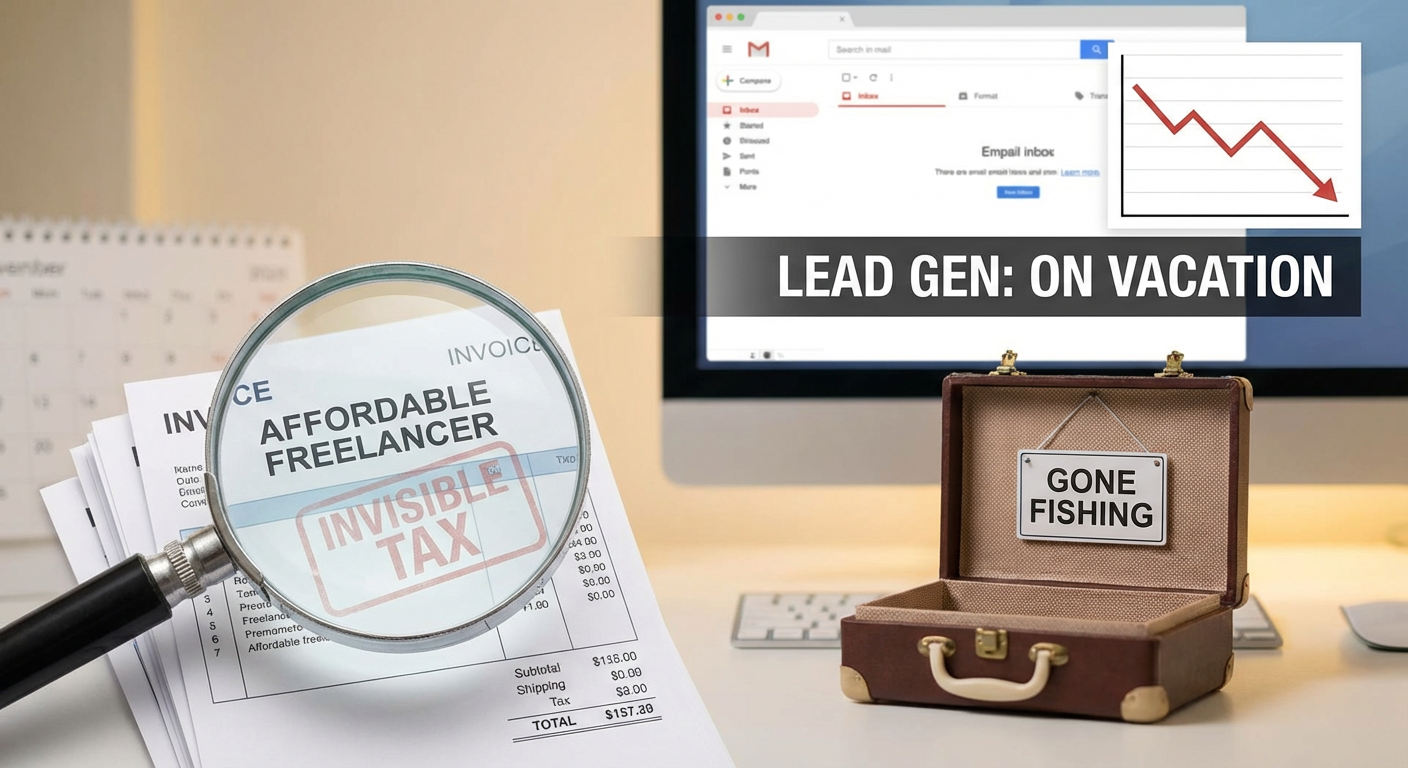
It’s 7:42 AM on a Tuesday.
Your phone buzzes.
You’re halfway through your first coffee when the email notification slides across the screen:
Subject: Out of Office
“Hi! I’m currently on vacation and will have limited access to email for the next two weeks.”
Your stomach tightens.
Because tomorrow… your campaign launches.
The paid ads are scheduled.
The landing pages are waiting.
The email sequence? Still in a Google Doc.
Your freelancer was supposed to finish it last night.
Now your lead generation engine—the one feeding your sales pipeline—is officially on pause.
Not because of strategy.
Not because of budget.
Because one person went offline.
And that’s the moment most companies discover something uncomfortable:
The real cost of the “affordable freelancer” isn’t their rate.
It’s the invisible tax of fragility.
The Freelancer Illusion: Cheap Until the System Breaks
Let’s start with the belief that drives this entire debate.
Freelancers save money.
And on paper, they absolutely do.
A freelance SEO specialist might cost $40–$80/hour.
A freelance content writer might charge $150 per article.
A paid ads freelancer might run campaigns for $1,000/month.
Compare that to an agency retainer and the math seems obvious.
Lower cost.
Less commitment.
More flexibility.
But here’s the bridge most businesses don’t see until it’s too late.
Freelancers reduce cost. Agencies reduce risk.
And those are two very different economic models.
One optimizes for price per task.
The other optimizes for continuity of outcomes.
If your freelancer disappears for two weeks, your marketing engine stalls.
If an agency loses a team member?
The machine keeps running.
The Real Problem: Your Marketing Has a SPOF
In engineering, there’s a term for this.
Single Point of Failure (SPOF).
A system with a SPOF works perfectly—until the one component holding everything together breaks.
Then the entire system collapses.
When your marketing depends on one freelancer, you’ve built a textbook SPOF.
That one person holds:
- The campaign strategy
- The keyword research
- The landing page logic
- The email automation setup
- The analytics interpretation
All of it.
Inside their head.
Inside their laptop.
Inside their availability.
Which means when they disappear, your marketing intelligence disappears with them.
This isn’t about talent.
Many freelancers are exceptional.
But individual brilliance is not the same thing as institutional memory.
Agencies build systems where knowledge lives across:
- shared documentation
- process frameworks
- multiple specialists
- operational playbooks
Freelancers rely on… well, themselves.
And when the system equals one person, your content marketing ROI becomes fragile by design.
The Safety Net Most Companies Don’t Realize They Need
If your current marketing setup depends on one freelancer, there’s a simple question worth asking:
Where are your hidden SPOFs?
A quick Marketing Vulnerability Audit can identify where your campaigns rely on a single operator, undocumented processes, or fragile handoffs.
Because the goal isn’t to fire freelancers.
It’s to make sure your lead generation system doesn’t collapse when someone logs off.
You’re Not Paying for a Partner. You’re Paying for a Technician.
Here’s the uncomfortable truth most companies avoid.
Freelancers usually deliver tasks.
Agencies deliver systems.
A freelancer might:
- write the article
- run the ads
- optimize the page
- send the emails
And if they’re good, the work is solid.
But the moment you ask for marketing scalability, the cracks start to appear.
Because scaling requires coordination:
- Strategy alignment
- Data feedback loops
- Channel orchestration
- Process documentation
That’s not a task.
That’s an operating model.
And most freelancers simply aren’t built to run one.
Not because they’re lazy.
Because freelancers operate like skilled technicians, while agencies operate like marketing infrastructure.
One fixes the pipe.
The other designs the plumbing.
The Hidden Cost of the “SEO Agency vs Freelancer” Debate
The internet loves the SEO agency vs freelancer debate.
Usually it’s framed like this:
Freelancer = cheaper
Agency = expensive
But that comparison misses the most important variable in marketing economics:
Downtime.
Let’s say your lead generation produces 50 qualified leads per month.
And each lead is worth roughly $500 in revenue potential.
That’s $25,000 of pipeline value every month.
Now imagine your freelancer disappears for two weeks.
Your campaigns stall.
Your content calendar freezes.
Your paid campaigns stop optimizing.
You lose half a month of momentum.
That’s not a $1,000 freelancer decision anymore.
That’s a $12,500 opportunity cost.
Suddenly the “agency premium” starts looking less like overhead and more like risk mitigation in outsourcing.
Redundancy: The Feature Nobody Talks About
Great marketing systems have something freelancers simply can’t replicate alone.
Redundancy.
In an agency environment:
- If the SEO strategist is unavailable, another strategist can step in.
- If the content writer misses a deadline, the editorial team fills the gap.
- If the ads manager is overloaded, another specialist takes the account.
The work doesn’t stop.
The system absorbs the shock.
That redundancy is what protects marketing scalability.
It ensures your campaigns keep running during:
- vacations
- illness
- unexpected client surges
- seasonal demand spikes
In other words, agencies are designed to survive real life.
Freelancer systems usually aren’t.
The Collective Brain Trust Advantage
One underrated advantage of working with an agency?
You’re not hiring a person. You’re hiring a room full of expertise.
Strategy meetings suddenly include:
- SEO specialists
- content strategists
- conversion copywriters
- paid acquisition experts
This fractional marketing team model allows companies to handle seasonal pushes—product launches, peak buying periods, aggressive growth phases—without rebuilding the entire marketing stack.
When demand spikes, the team expands.
When campaigns stabilize, the system maintains momentum.
That’s the difference between a service provider and a marketing engine.
Checklist for Redundancy: Is Your Marketing System Fragile?
Before deciding between freelancers or agencies, run your marketing through this quick redundancy test.
If you answer “no” to most of these, you likely have hidden SPOFs.
Marketing Redundancy Checklist
- Does more than one person understand your SEO strategy?
- Are campaign processes documented anywhere?
- Can someone else access and manage your ad accounts immediately?
- Is your content calendar shared and structured?
- Do multiple team members understand your analytics dashboards?
- Is there a backup if your primary marketer disappears for two weeks?
- Do you have a system for scaling output during peak seasons?
If the answer to most of these is no, your marketing isn’t a system.
It’s a dependency.
And dependencies eventually fail.
The Freelancer Economy Isn’t the Problem
Let’s be clear.
Freelancers aren’t the villain here.
In fact, the freelance economy has produced some of the most talented specialists in marketing.
The problem is when companies try to run mission-critical growth systems on top of solo operators.
That’s like building a skyscraper on a single support column.
It works… right until it doesn’t.
Freelancers are excellent for:
- specialized projects
- overflow work
- technical expertise
- short-term experiments
But if your revenue pipeline depends on consistent lead generation, the infrastructure needs to be stronger than one calendar.
The Hard Truth About Affordable Marketing
Most companies don’t choose freelancers because they love freelancers.
They choose them because they’re trying to control cost.
That’s understandable.
But growth-stage businesses eventually discover a difficult reality:
Cheap marketing systems often become the most expensive ones.
Not because the work is bad.
Because the system is fragile.
The real question isn’t:
“How much does marketing cost?”
It’s:
“What does marketing downtime cost?”
When your pipeline slows, your sales team feels it.
When sales slow, your revenue forecasts collapse.
When forecasts collapse, the board starts asking questions.
And suddenly that affordable freelancer decision is sitting in the center of a much bigger problem.
The Brands That Scale Build Systems, Not Dependencies
High-growth companies treat marketing differently.
They don’t buy tasks.
They build engines.
Engines that can:
- absorb shocks
- scale output
- preserve institutional memory
- keep campaigns moving even when people change
That’s why the smartest brands eventually transition toward fractional marketing teams and agency partnerships.
Not because agencies are perfect.
But because systems beat individuals when stakes get high.
The Final Question Every Founder Has to Ask
Here’s the uncomfortable question most businesses avoid:
Is your marketing built to grow… or just to function?
If your growth engine depends on one freelancer staying healthy, available, and motivated 365 days a year, you’re not running a system.
You’re running a gamble.
And sooner or later, every gamble runs out of luck.
That’s why more companies are turning to structured marketing teams like Alternative Marketing—not for more tasks, but for something far more valuable:
Continuity.
Because in growth marketing, the real luxury isn’t creativity.
It’s reliability.
And the moment your lead generation goes silent, that invisible tax becomes painfully visible.
Leave a Reply