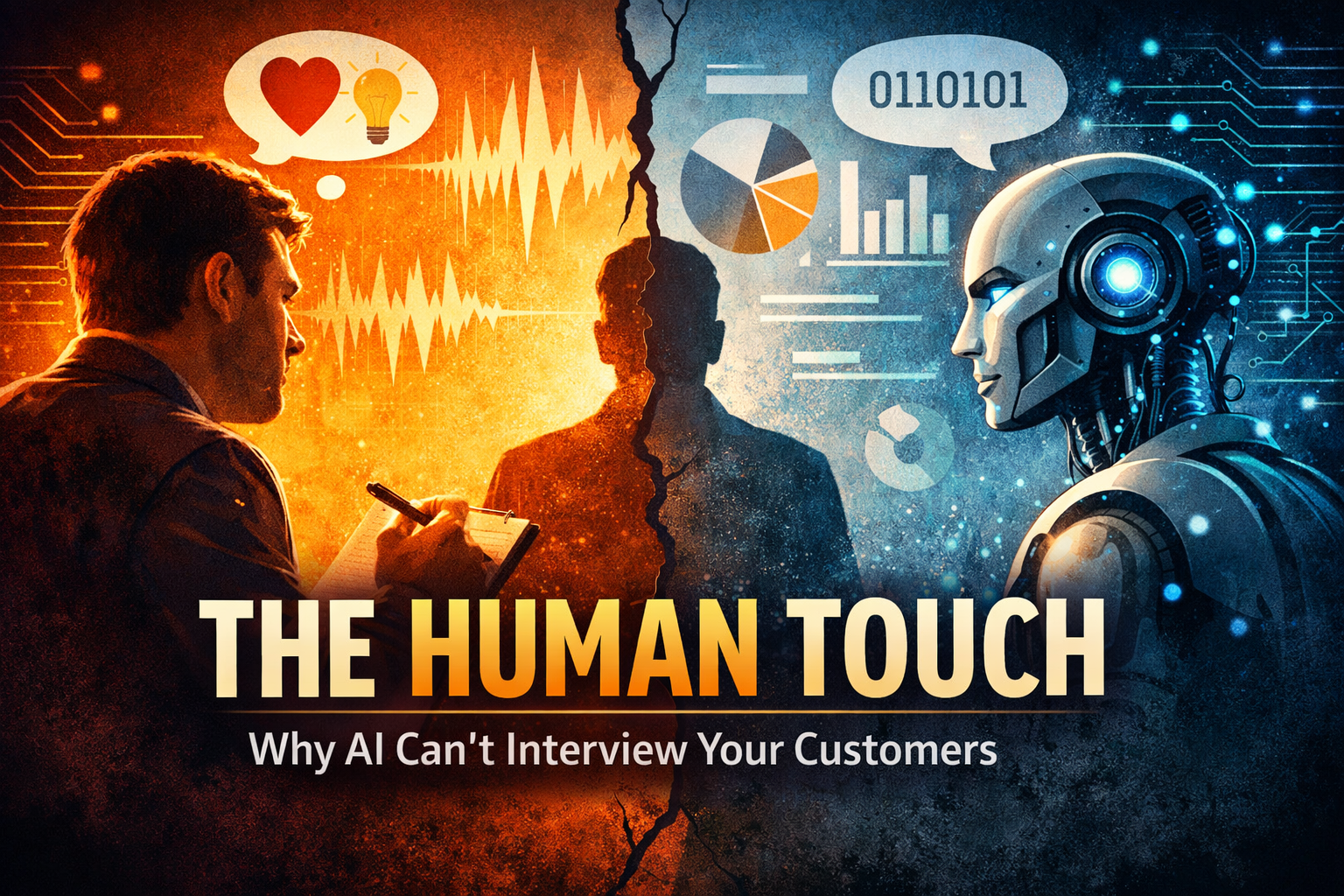
The Efficiency Trap
It starts the same way every time.
A dashboard lights up with 10,000 data points. Heatmaps. Session recordings. AI-generated summaries of customer reviews. Sentiment analysis distilled into clean, color-coded charts.
Everything feels… complete.
You scroll. You skim. You nod.
“Got it,” you think. “Customers want faster onboarding. Simpler pricing. Better support.”
But something is off.
Because none of it feels like a real conversation. There’s no tension. No contradiction. No hesitation before the answer. No moment where someone almost says the truth—then pulls back.
It’s all signal. No story.
This is the Efficiency Trap: when the speed and scale of AI-generated insight creates the illusion of understanding—while quietly stripping away the very thing that drives conversion.
Reality is messier. More human. More uncomfortable.
And that’s exactly where the real insight lives.
The Hero’s Journey of Insight
In a world obsessed with automation, the real competitive advantage is no longer data.
It’s interpretation.
The protagonist in modern market research isn’t the AI model parsing thousands of responses. It’s the human researcher sitting across from a customer, noticing something subtle:
- The pause before answering a pricing question
- The slight frustration masked as politeness
- The offhand comment that doesn’t fit the script
That’s where the story begins.
Because customers don’t reveal their truth in structured fields. They leak it—in fragments, contradictions, and “interstitial moments” between the obvious answers.
This is the work of Customer Discovery at its highest level: not collecting responses, but uncovering the narrative underneath them.
AI can document what is said.
Humans uncover why it matters.
The “Synthetic” Wall: Where AI Hits Its Limits
Let’s be clear: AI is exceptional at what it’s designed to do.
- Transcribing interviews
- Clustering responses
- Identifying surface-level patterns
- Summarizing large datasets
That’s valuable. Essential, even.
But it all breaks down at the same point: contextual blindness.
AI predicts the next word.
Humans predict the next emotion.
And those are not the same thing.
Why Context Matters More Than Content
Imagine a customer says:
“Yeah, the product works fine. No major issues.”
To AI, this is neutral-to-positive sentiment.
To a trained interviewer, it’s a red flag.
Because the way it’s said matters:
- Was there hesitation?
- Did they avoid eye contact?
- Did they previously mention a workaround?
This is the “Synthetic Wall”—the point where AI can no longer infer meaning because meaning isn’t in the words. It’s in the delivery.
This is where most AI Content Limitations quietly sabotage otherwise sophisticated strategies.
You end up optimizing for what customers say—instead of what they actually feel.
And that gap is where conversions die.
The Five Whys: Where Real Insight Begins
Surface-level answers are polite. Socially acceptable. Often rehearsed.
The truth requires pressure.
The classic “Five Whys” framework isn’t powerful because of the questions—it’s powerful because of the persistence.
But here’s what most teams miss:
The magic isn’t in asking “why” five times.
It’s in knowing when to stop asking—and when to pivot entirely.
A Simple Example
Customer: “We chose your competitor because their pricing was clearer.”
Why #1: “What made it clearer?”
→ “It was just easier to understand.”
Why #2: “What felt confusing about ours?”
→ “Too many options.”
Why #3: “What made multiple options a problem?”
→ “We didn’t know what we actually needed.”
Why #4: “Why was that unclear?”
→ Pause “…we’re not really experts in this space.”
Now we’re getting somewhere.
But here’s the turning point—the moment AI would miss.
A human interviewer notices the hesitation. The slight drop in confidence.
And pivots:
Why #5 (Human Pivot): “It sounds like the bigger issue wasn’t pricing—it was uncertainty. Is that fair?”
That’s the insight.
Not pricing clarity.
Buyer insecurity.
Where We Step In (Mid-Conversation)
This is exactly where our team operates differently.
We don’t just run interviews—we redirect them in real time, based on those subtle cues most teams (and all AI systems) miss.
If you’re relying on post-interview analysis alone, you’re already too late. The most valuable insight is often sitting in the moment you didn’t think to explore.
Reading the Room: The Agency Advantage
There’s a phrase that doesn’t get enough attention in Market Research Strategy:
“Read the room.”
It sounds informal. Almost unscientific.
But it’s one of the highest-leverage skills in qualitative research.
What “Reading the Room” Actually Means
It means recognizing:
- When a customer is giving you the “safe” answer
- When they’re testing how honest they can be
- When they’re waiting for permission to say something uncomfortable
And most importantly:
When to break the script.
Because the script is where average insights live.
The unscripted moment? That’s where strategy changes.
The Power of the Non-Verbal Cue
A slight hesitation can signal:
- Pricing anxiety
- Internal stakeholder conflict
- Fear of making the wrong decision
A quick answer can signal:
- Rehearsed objections
- Market conditioning
- Surface-level understanding
These are not data points.
They are signals.
And they require interpretation, not computation.
Synthesis vs. Summary: The Strategic Divide
Here’s where most AI-driven workflows collapse:
They confuse summary with synthesis.
Summary Is Compression
- “60% of users mentioned onboarding challenges.”
- “Pricing confusion appeared in 35% of responses.”
Useful? Yes.
Strategic? Not yet.
Synthesis Is Transformation
Synthesis connects dots across conversations to reveal something deeper:
- Onboarding isn’t the problem—confidence is
- Pricing confusion is actually decision paralysis
- Feature requests are often proxies for missing trust
This is Narrative Synthesis—the process of turning fragmented human experiences into a cohesive, actionable story.
And it’s the foundation of Human-Centric SEO.
Because search engines don’t rank information.
They rank alignment with intent.
Our Proprietary Edge
This is where our internal framework comes in.
We don’t just aggregate responses—we map emotional drivers, decision triggers, and narrative patterns into a structure that directly informs:
- Landing page messaging
- Content strategy
- Conversion flows
The result isn’t just better content.
It’s content that feels like it was written by the customer, for the customer.
The ROI of Qualitative Truth
Let’s talk about Qualitative Research ROI, because this is where skepticism usually shows up.
“Isn’t this slower?”
“Isn’t this harder to scale?”
Yes.
And that’s the point.
Because what you gain isn’t efficiency—it’s precision.
What One Insight Can Do
A single, deeply understood customer truth can:
- Reshape your entire positioning
- Double conversion rates on key pages
- Eliminate wasted spend on misaligned messaging
- Unlock entirely new market segments
Compare that to optimizing headlines based on shallow data.
One is incremental.
The other is transformational.
Edge Cases: Where AI Fails the Hardest
AI performs best in predictable environments.
But real markets aren’t predictable.
They’re full of edge cases—the exact scenarios where insight matters most.
These Are the Moments AI Misses:
- Contradictory behavior: Customers say one thing, do another
- Emerging markets: No historical data to train on
- Emotional decisions: Fear, status, identity
- Complex B2B buying cycles: Multiple stakeholders, hidden objections
- Unarticulated needs: Problems customers can’t yet describe
These are not outliers.
They are where competitive advantage is built.
The Hybrid Path: Engine vs. Driver
Let’s not pretend this is a binary choice.
AI is not the enemy.
It’s the engine.
But an engine without a driver doesn’t win races.
The Real Strategy
Use AI for:
- Speed
- Scale
- Organization
- Pattern detection
Use humans for:
- Interpretation
- Emotional intelligence
- Strategic pivots
- Narrative construction
That’s the hybrid model.
That’s the future.
And that’s where most companies are currently underinvesting.
The Closer: Your Competitive Advantage Isn’t Data—It’s Understanding
Right now, your competitors have access to the same tools you do.
The same AI models.
The same data pipelines.
The same automation workflows.
So the question isn’t:
“Who has more data?”
It’s:
“Who understands their customer better?”
Because in a world saturated with AI-generated content, the only thing that cuts through is something that feels unmistakably human.
Something that captures the hesitation.
The uncertainty.
The unspoken truth.
A Different Kind of Audit
If you’re serious about closing that gap, the next step isn’t another dashboard.
It’s a conversation.
We call it a Human Insight Audit.
Not a surface-level review of your analytics—but a deep dive into the narratives driving your customers’ decisions.
Because once you hear what they’re really saying…
You can’t unhear it.
And neither will your market.
Leave a Reply