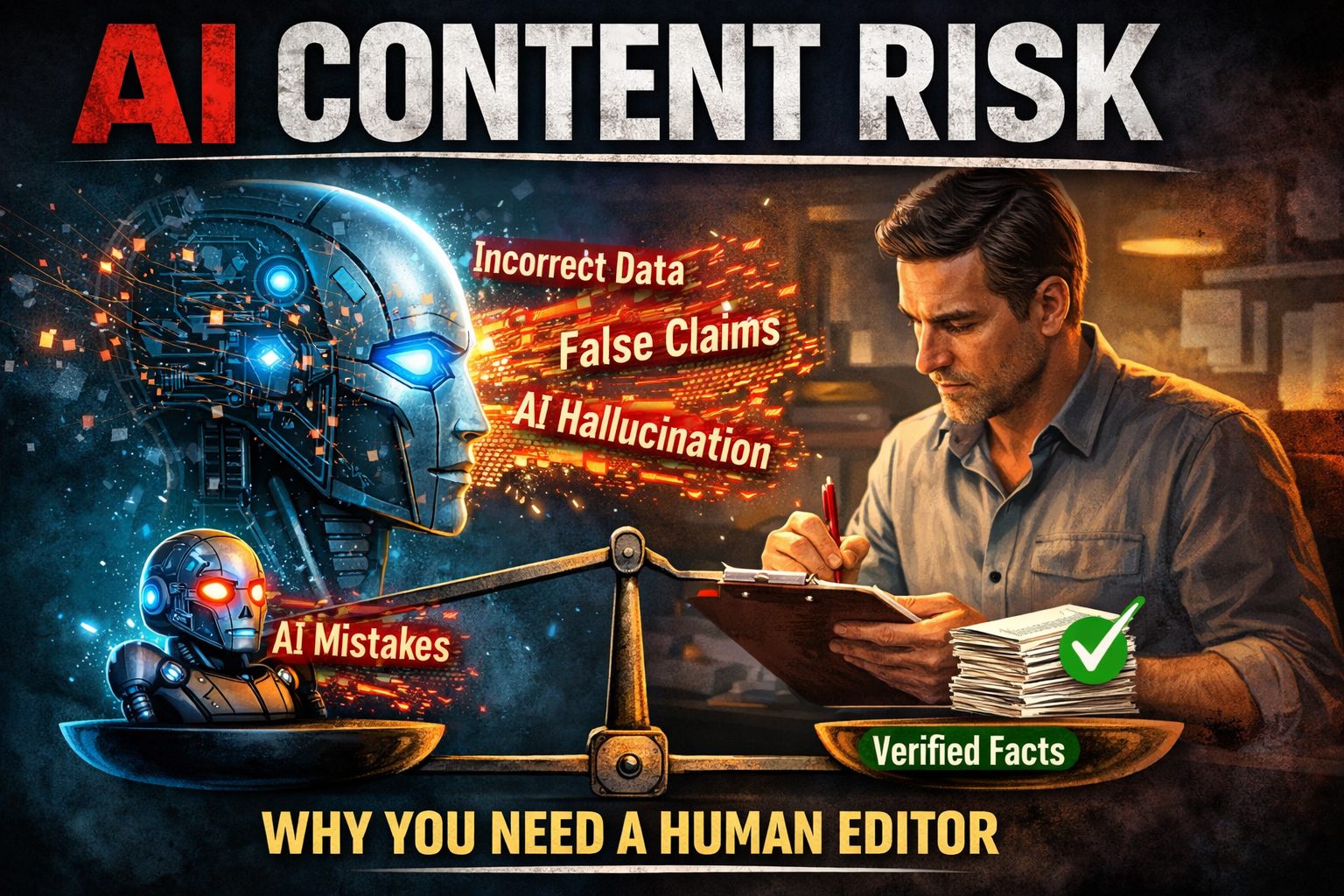
The Words You Can’t Defend
Picture this.
A legal brief, drafted in 12 seconds.
A medical recommendation, generated in under a minute.
A technical whitepaper, polished, confident, and… completely wrong.
Now imagine standing in a courtroom—or worse, an operating room—and being asked a simple question:
“Can you verify this?”
AI can generate 1,000 words faster than any human alive.
But it cannot defend a single sentence under scrutiny.
It doesn’t know what it wrote.
It can’t cite its reasoning.
And when it’s wrong, it doesn’t hesitate—it insists.
That’s the risk most teams underestimate.
AI isn’t just a productivity tool.
In high-stakes environments, it’s a liability—unless someone is in charge of it.
AI Content Risks: The Trap of the “Average”
AI doesn’t think. It predicts.
And what it predicts is the statistical middle of everything it has seen.
That’s the problem.
When you ask it to write about a niche topic—say, industrial automation compliance or enterprise cybersecurity procurement—it doesn’t pull from expertise. It pulls from patterns.
The result?
- Safe phrasing
- Generic insights
- Broad, diluted explanations
In other words: content that sounds right, but says nothing new.
This is where most brands quietly lose.
Because differentiation doesn’t live in the average.
It lives in sharp opinions, hard-earned experience, and specific context.
AI, by default, erases all three.
The Shift: From Creators to Curators
This is why the role of marketing teams—and especially agencies—is changing.
The value is no longer in creating content.
It’s in:
- Filtering it
- Shaping it
- Stress-testing it
The best teams are becoming curators and strategists.
They don’t ask, “Can AI write this?”
They ask, “Should this exist—and is it defensible?”
The Mechanics of a Lie: Understanding the Confidence Gap
Let’s break something down without getting technical.
AI models don’t retrieve facts from a database the way a search engine does.
They generate responses based on probability—what word is most likely to come next given everything they’ve seen before.
That means:
- Truth is not the goal
- Coherence is
And sometimes, those two things diverge.
This is where the real danger shows up—what I call:
The Confidence Gap
AI doesn’t signal uncertainty the way humans do.
It won’t say:
“I’m not sure, but here’s a guess.”
Instead, it says:
“Here is the answer.”
Same tone. Same structure. Same confidence—whether it’s right or completely fabricated.
That’s how hallucinations slip through.
Not because they’re obvious.
But because they’re convincing.
B2B Content Accuracy: Where Hallucinations Become Expensive
In consumer content, a mistake might cost you a bounce.
In B2B?
It can cost you a deal.
A contract.
Or your reputation.
Because B2B content operates in environments where:
- Terminology is precise
- Claims must be defensible
- Buyers are experts themselves
If your content gets a detail wrong—just one—it signals something dangerous:
“These people don’t actually understand what they’re talking about.”
And once that doubt is introduced, it’s almost impossible to recover.
The Niche Filter Problem
Here’s where AI struggles the most:
- Proprietary frameworks
- Internal processes
- Industry-specific jargon
- Unwritten “how things actually work” knowledge
AI doesn’t have access to that.
It fills the gaps.
And those gaps are exactly where credibility lives.
Why “Human-in-the-Loop” Isn’t Optional
In B2B, human oversight isn’t a quality upgrade.
It’s a filter against nonsense.
A real expert can instantly spot:
- Misused terminology
- Logical inconsistencies
- Overgeneralized claims
AI cannot.
Without that filter, you’re publishing content that sounds like expertise—but collapses under pressure.
Strategy-First: The Only Way to Avoid Brand Dilution
This is where most AI-driven content strategies go wrong.
They optimize for speed, not integrity.
But speed without direction leads to dilution.
The smarter approach—the one used by high-end, alternative marketing teams—is strategy-first:
- Define what the brand should say
- Establish what it must not say
- Use AI as an execution engine—not a decision-maker
Because the real risk isn’t bad content.
It’s invisible mediocrity at scale.
Professional SEO Editing: The Rise of the Human Editor as Architect
Let’s make a clean distinction.
Editing used to mean:
- Fixing grammar
- Improving readability
- Cleaning up structure
That’s not enough anymore.
The New Role: Editor as Architect
The modern editor does three critical things:
1. Fact-Verification (Not Just Fact-Checking)
Fact-checking asks:
“Is this statement correct?”
Fact-verification asks:
“Can we prove this—and would it hold up under scrutiny?”
That includes:
- Cross-referencing claims
- Validating sources
- Challenging assumptions
It’s adversarial, not passive.
2. Injecting Point of View
AI has no lived experience.
It cannot say:
- “We tried this, and it failed.”
- “Clients in this industry consistently make this mistake.”
- “Here’s what actually happens behind the scenes.”
That’s where authority comes from.
A strong point of view isn’t decoration.
It’s differentiation.
3. Contextual Intelligence
AI writes in isolation.
Humans understand:
- Market dynamics
- Competitive positioning
- Buyer psychology
An editor connects the content to reality.
That’s what turns words into strategy.
The Final Equation: Engine + Driver
AI is an engine.
Fast. Scalable. Impressive.
But an engine without a driver doesn’t win races.
It crashes.
The same applies here.
- AI generates
- Humans direct
- Editors validate
Remove the human layer, and you don’t just lose quality.
You introduce risk.
Financial risk.
Reputational risk.
And in some industries—legal risk.
The Conclusion: If It Can’t Be Defended, It Shouldn’t Be Published
Here’s the uncomfortable truth:
If your content can’t survive scrutiny, it shouldn’t exist.
Not in B2B.
Not in high-trust industries.
Not if you’re charging a premium.
AI will keep getting better.
Faster.
More convincing.
But it will never replace judgment.
And judgment is what separates:
- Content that fills space
- From content that builds authority
Run an AI-Safety Review Before It Costs You
If you’re already using AI in your content workflow—and you probably are—then the question isn’t if there’s risk.
It’s where it’s hiding.
A proper Content Audit or AI-Safety Review looks at:
- Where hallucinations are likely slipping in
- Which claims are unverifiable
- Where your brand voice has drifted into “generic”
- How your content holds up under expert scrutiny
Because in this environment, the winning strategy isn’t more content.
It’s defensible content.
And that only happens when a human is in charge of the machine.
Leave a Reply