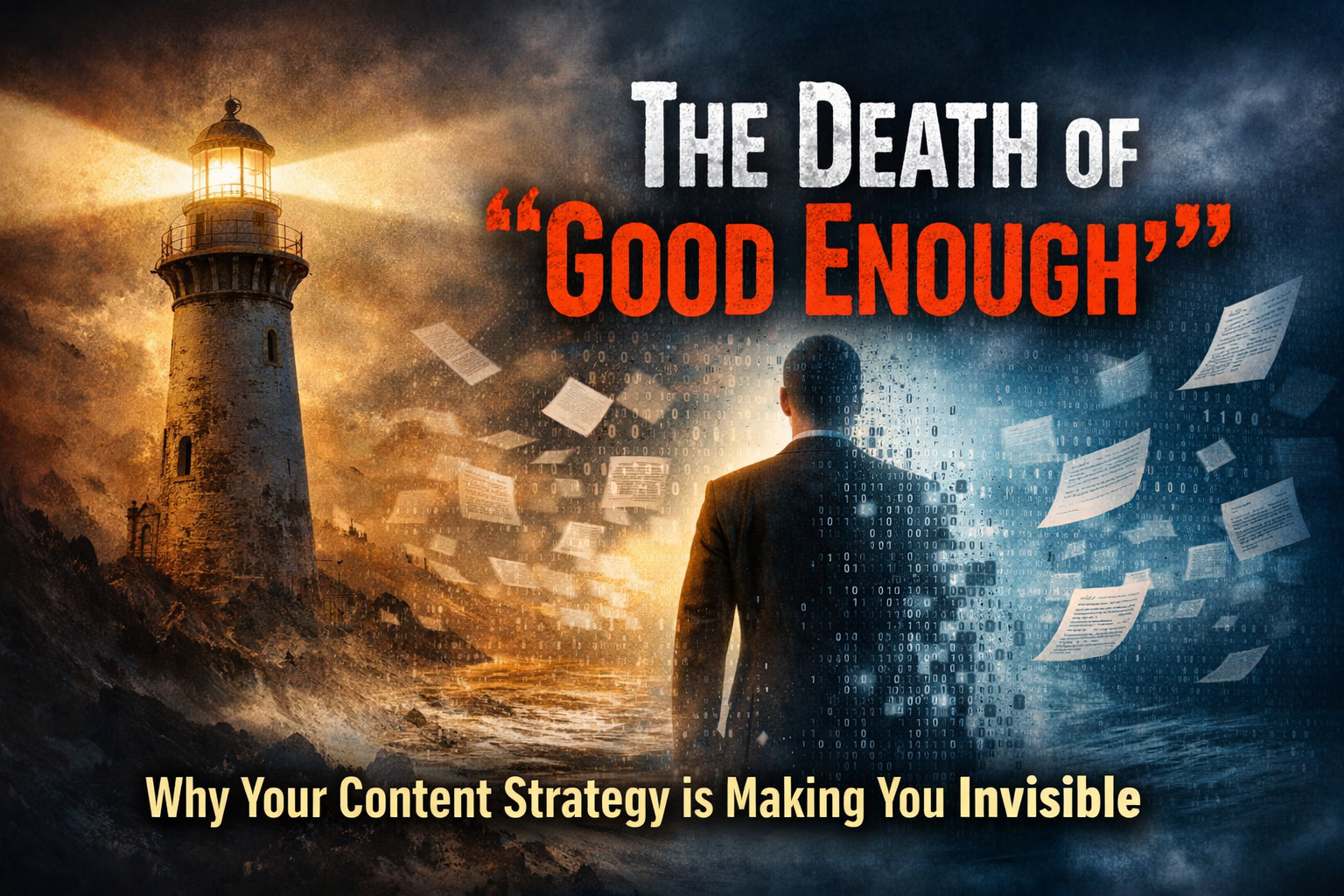
Here’s the uncomfortable truth no one in SEO wants to say out loud:
You’re not competing against better content anymore. You’re competing against infinite content.
And infinite always wins—unless you change the game.
The Flood No One Prepared You For
A year ago, “good enough” content could still rank.
Decent keyword targeting.
Clean structure.
Maybe a bit of optimization sprinkled on top.
That playbook is dead.
Today, the internet is flooded with content that is:
- Technically correct
- Structurally sound
- Optimized for keywords
- And completely forgettable
AI didn’t just lower the cost of content.
It collapsed it to zero.
Which means the baseline for “good enough” is now everywhere. And when everything is good enough…
Nothing stands out. Nothing ranks. Nothing converts.
The Silent Killer: SGE and the Disappearing Click
Here’s where it gets worse.
Search engines are no longer just ranking your content.
They’re absorbing it.
With AI-generated summaries (SGE), your article doesn’t just compete for position #1—it competes to even exist.
If your content can be summarized in 3 bullet points…
It will be.
And the click? Gone.
Why Your Old SEO Strategy Is Failing (Even If It “Worked” Before)
Let’s break the illusion.
Most content strategies today are still built on three outdated assumptions:
1. “If I cover the topic well, I’ll rank”
No.
If you cover the topic the same way everyone else does…
You’ve just joined the noise.
2. “More content = more traffic”
That used to be true when supply was limited.
Now?
More content = more dilution.
We’ve seen sites publish 200+ articles in a quarter and lose traffic. Why?
Because they trained search engines to see them as statistical averages, not authorities.
3. “Optimization is the edge”
Optimization is now table stakes.
Everyone has:
- Perfect headings
- Clean keyword distribution
- Semantic coverage
Optimization doesn’t differentiate anymore.
It normalizes.
The Real Problem: You’re Writing for Algorithms, Not Humans
Here’s the part most people miss.
Search engines don’t reward content.
They reward behavior.
And behavior is driven by one thing:
Psychological friction.
If your content:
- Feels predictable
- Sounds generic
- Adds nothing new
The user disengages.
And when users disengage, rankings follow.
What We’ve Observed in High-Stakes Audits
In our recent audit of multiple B2B sites competing in saturated niches, we noticed a pattern:
- The top-ranking content wasn’t always the most “complete”
- It wasn’t the longest
- It wasn’t even the most optimized
It was the most distinct
The content that won had:
- A clear point of view
- Original framing
- A sense of authorship
Meanwhile, the “perfectly optimized” articles?
They blended into the background.
The Shift: From Volume to Authority
If “good enough” is invisible, what replaces it?
Not better formatting.
Not more keywords.
Authority.
But not the buzzword version of authority.
Real authority is built on three pillars:
1. Original Insight (Not Rewritten Consensus)
If your content can be recreated by AI in 30 seconds…
It has no defensible value.
Authority comes from:
- Unique angles
- Contrarian takes
- Synthesizing ideas others haven’t connected
2. Lived Experience (Even if Simulated Strategically)
Here’s a hard truth:
People trust experience, not summaries.
That’s why phrases like:
- “We’ve observed…”
- “In our audit…”
- “We tested…”
Carry weight.
They signal something AI struggles to replicate:
Context.
3. Narrative Control
Most content answers questions.
Authority content reframes them.
Instead of:
“How do I improve SEO?”
It asks:
“Why are most SEO strategies designed to fail in saturated markets?”
That shift alone changes how the reader engages.
⚡ Key Takeaway (The 80/20 Rule)
80% of content fails because it tries to be complete.
The top 20% wins because it dares to be distinct.
Stop asking:
“Did we cover everything?”
Start asking:
“Did we say anything that actually matters?”
The “Human-Plus” Strategy: Your Only Real Edge
Let’s be blunt.
You’re not going to outproduce AI.
You’re not going to out-optimize the competition.
So what can you do?
You combine what AI does best with what it fundamentally lacks.
This is the Human-Plus Strategy.
AI’s Role: Scale and Structure
Use AI for:
- Drafting
- Structuring
- Expanding ideas
Let it handle the mechanical work.
Your Role: Judgment and Depth
You step in for:
- Insight
- Opinion
- Strategic direction
You inject:
- What others missed
- What others won’t say
- What only experience reveals
The Result: Content That Can’t Be Commoditized
This is the key.
You’re not trying to make content better.
You’re making it harder to replicate.
The Pattern Interrupt Most Teams Need
Let’s pause for a second.
If you’re tired of publishing content that feels like a statistical average…
This is where our proprietary Content Moat framework comes in.
Because the real problem isn’t your writers.
It’s your system.
Most teams are optimized for:
- Speed
- Output
- Consistency
But not for:
- Insight
- Differentiation
- Authority
And that’s exactly why they plateau.
The SGE Shield: Writing What Can’t Be Summarized
Here’s a practical test for your next article:
Can this be reduced to a snippet without losing its value?
If yes, it’s vulnerable.
If no, you’re on the right track.
Content that resists summarization has:
- Nuance
- Perspective
- Tension
It forces the reader to engage, not skim.
The Hidden Cost of Staying “Good Enough”
Most businesses don’t notice the decline immediately.
It looks like:
- Slight ranking drops
- Lower CTR
- Slower growth
But over time?
It compounds into invisibility.
Because while you’re producing “good enough”…
Someone else is building a content moat.
What the Future Actually Rewards
Let’s simplify it.
The next era of SEO won’t reward:
- The most content
- The most optimized content
- The fastest publishers
It will reward:
The clearest thinkers.
The ones who:
- Say something worth remembering
- Challenge assumptions
- Build trust through perspective
The Final Shift: From Lighthouse to Signal
Most content today is noise trying to be heard.
What you need is a lighthouse.
Something that:
- Cuts through the fog
- Signals authority instantly
- Guides the right audience to you
That doesn’t come from volume.
It comes from intentional differentiation.
The Hard Truth (and the Opportunity)
You don’t have a content problem.
You have a uniqueness problem.
And the longer you ignore it, the more invisible you become.
Stop auditing your word count.
Stop obsessing over keyword density.
Start auditing one thing:
Would anyone care if this content didn’t exist?
If the answer is no…
It’s already costing you more than you think.
And if you’re ready to fix that—
to build content that doesn’t just rank, but dominates—
Let’s build your lighthouse of genuine authority.
Leave a Reply