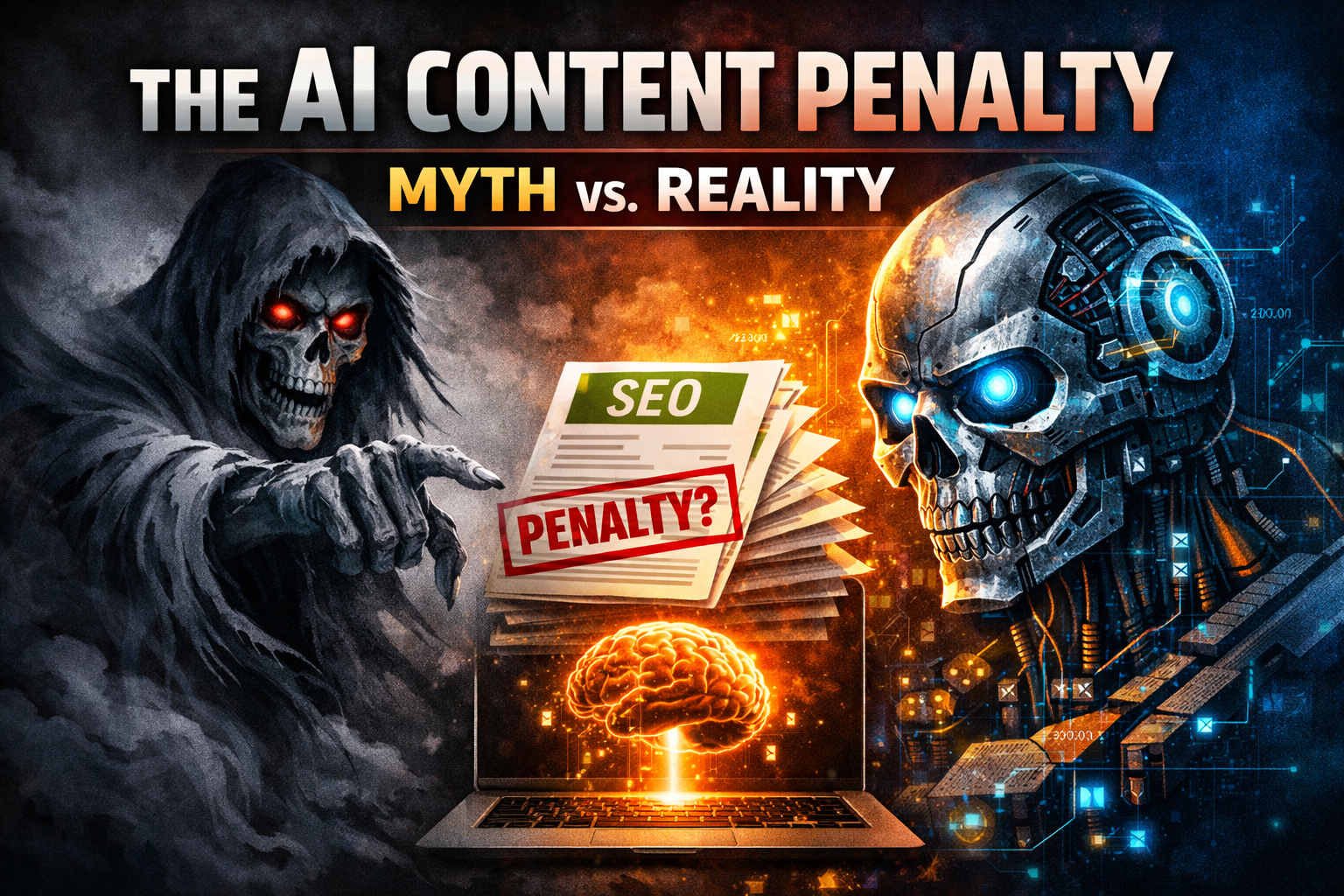
There’s a quiet war happening inside marketing departments right now.
On one side, you have the old guard—labor-intensive agencies selling “craft,” billing by the hour, and treating every blog post like a handcrafted sculpture.
On the other side, you have the AI wave: fast, scalable, terrifyingly efficient.
One side says AI is cheating.
The other says it’s the future.
And floating somewhere in the middle is a ghost.
The Penalty Ghost.
You’ve heard the whispers.
“Google can detect AI.”
“Sites using AI will get penalized.”
“AI content will destroy your rankings.”
So companies hesitate.
Writers panic.
Agencies sell fear.
But here’s the brutal truth.
Google doesn’t care how the sausage is made.
It only cares if the sausage is good.
The real danger isn’t AI content.
The real danger is scaling mediocrity faster than ever before.
Let’s talk about the ghost.
The Detection Paradox: The Ghost Everyone Talks About
If you spend five minutes on LinkedIn, you’ll find dozens of posts claiming that Google can detect AI-generated content.
Some even claim they’ve “reverse engineered” the signals.
They haven’t.
Most of what passes for AI detection today is security theater.
The same way airport scanners make people feel safer while missing half the threats, AI detectors create the illusion of authority.
They produce scores.
“82% AI.”
“47% Human.”
It looks scientific.
It feels technical.
It’s mostly nonsense.
Even the companies building these tools admit their accuracy rates are inconsistent.
Why?
Because AI and humans now write using the same statistical patterns.
Language models were trained on human writing.
Human writers are now influenced by AI.
The signals have blended.
There is no clean fingerprint.
Which creates the paradox.
If Google could perfectly detect AI…
It would immediately become useless.
Because the moment a signal becomes known, it becomes optimized against.
Search history has proven this repeatedly.
- Keyword density signals disappeared.
- Meta keyword signals disappeared.
- Exact-match anchor dominance disappeared.
Every detectable signal eventually gets gamed.
So Google shifted strategies.
Instead of asking:
“Was this written by AI?”
They ask:
“Does this page deserve to exist?”
That’s a much harder problem.
And it leads us to the real issue.
The Zero-Margin Commodity of Words
Words are now cheap.
Not inexpensive.
Cheap.
The marginal cost of generating 1,000 words has effectively collapsed to zero.
Anyone with an AI tool can produce:
- blog posts
- landing pages
- product descriptions
- comparison guides
At scale.
This changes the economics of content.
Dramatically.
When supply explodes, one thing happens:
Average quality collapses.
The internet is already flooding with:
- recycled ideas
- shallow summaries
- synthetic “expertise”
- content that exists only because a keyword exists
AI didn’t create this problem.
It accelerated it.
And that’s where the Penalty Ghost gets misinterpreted.
Google isn’t penalizing AI.
Google is filtering noise.
Which leads to a counter-intuitive insight most marketers miss.
Counter-Intuitive Insight: Perfect Writing Is Often a Red Flag
AI is extremely good at something humans rarely achieve:
perfect grammar.
Every sentence balanced.
Every comma correct.
Every paragraph clean.
Ironically, this is one of the subtle signals of synthetic content.
Not because it proves AI was used.
But because real experts rarely write perfectly.
Experts write like this:
- they jump ahead
- they interrupt themselves
- they emphasize strange details
- they include industry assumptions
Human expertise is messy.
AI defaults to textbook clarity.
Which means the real signal Google likely watches isn’t “AI detection.”
It’s something more powerful.
Information gain.
Information Gain: The Metric That Actually Matters
Imagine two articles ranking for the same topic.
Article A:
A clean, well-written AI summary of existing knowledge.
Article B:
A messy, opinionated piece written by someone with 10 years of experience who introduces new insights.
Which one should rank?
The second one.
Not because it’s human.
Because it adds information to the ecosystem.
Search engines are essentially information retrieval systems.
Their job isn’t to reward content creation.
Their job is to maximize knowledge density per query.
Which leads to a brutal realization.
Most content doesn’t add knowledge.
It adds volume.
AI just made this problem obvious.
And that’s where agencies either become obsolete—or indispensable.
The Agency Mandate: Human-in-the-Loop Intelligence
If AI can generate content, what is the agency actually responsible for?
Not writing.
Not anymore.
The agency’s role is information architecture and strategic intelligence.
Think of it this way.
AI can assemble sentences.
But it cannot reliably answer questions like:
- What contrarian angle will shift market perception?
- Which insights does the search landscape lack?
- What opinion will attract backlinks?
- Where does the narrative tension live?
Those require context, experience, and strategic judgment.
Which is why the modern content stack looks like this:
AI = production layer
Humans = intelligence layer
Without the second layer, AI just produces synthetic averages.
And averages rarely rank.
They certainly don’t build authority.
This leads to the hybrid model.
The Hybrid Model: AI Builds the Skeleton. Strategy Adds the Soul.
The best content teams today don’t fight AI.
They orchestrate it.
AI produces the skeleton:
- first drafts
- research summaries
- structural outlines
- data extraction
Fast.
Efficient.
Scalable.
But skeletons don’t move.
They need a nervous system.
They need intent.
They need strategic tension.
That’s where the agency comes in.
The agency injects:
- original analysis
- controversial viewpoints
- data interpretation
- narrative structure
In other words:
the soul.
Without it, AI content is just a warehouse of organized sentences.
And warehouses don’t rank.
Stories do.
Insights do.
Authority does.
If you’re tired of scaling mediocrity, our agency builds the soul for your AI skeleton.
Let’s talk strategy.
The Real Risk: Scaling Mediocrity at Machine Speed
The companies that lose in the AI era won’t be the ones using AI.
They’ll be the ones using it lazily.
AI allows mediocre strategies to scale faster than ever before.
Which creates an ironic outcome.
Websites can now produce 1000 pages of useless content in the time it once took to publish ten.
Search engines adapt accordingly.
Not by detecting AI.
But by raising the bar for relevance.
Which brings the ghost story full circle.
The Verdict: Speed vs Significance
The Penalty Ghost isn’t real.
But the quality filter absolutely is.
And it’s getting stricter.
AI has changed content production forever.
But it hasn’t changed the fundamental rule of search:
Information beats repetition.
Companies now face a choice.
They can chase speed and flood the internet with synthetic summaries.
Or they can combine machine efficiency with human insight to produce something rarer:
content with strategic gravity.
One approach scales noise.
The other builds authority.
If you’re serious about the second path, the question isn’t whether to use AI.
It’s who’s guiding it.
And if you want AI that builds authority instead of amplifying mediocrity, our agency specializes in giving strategy—and soul—to the machines.
Leave a Reply