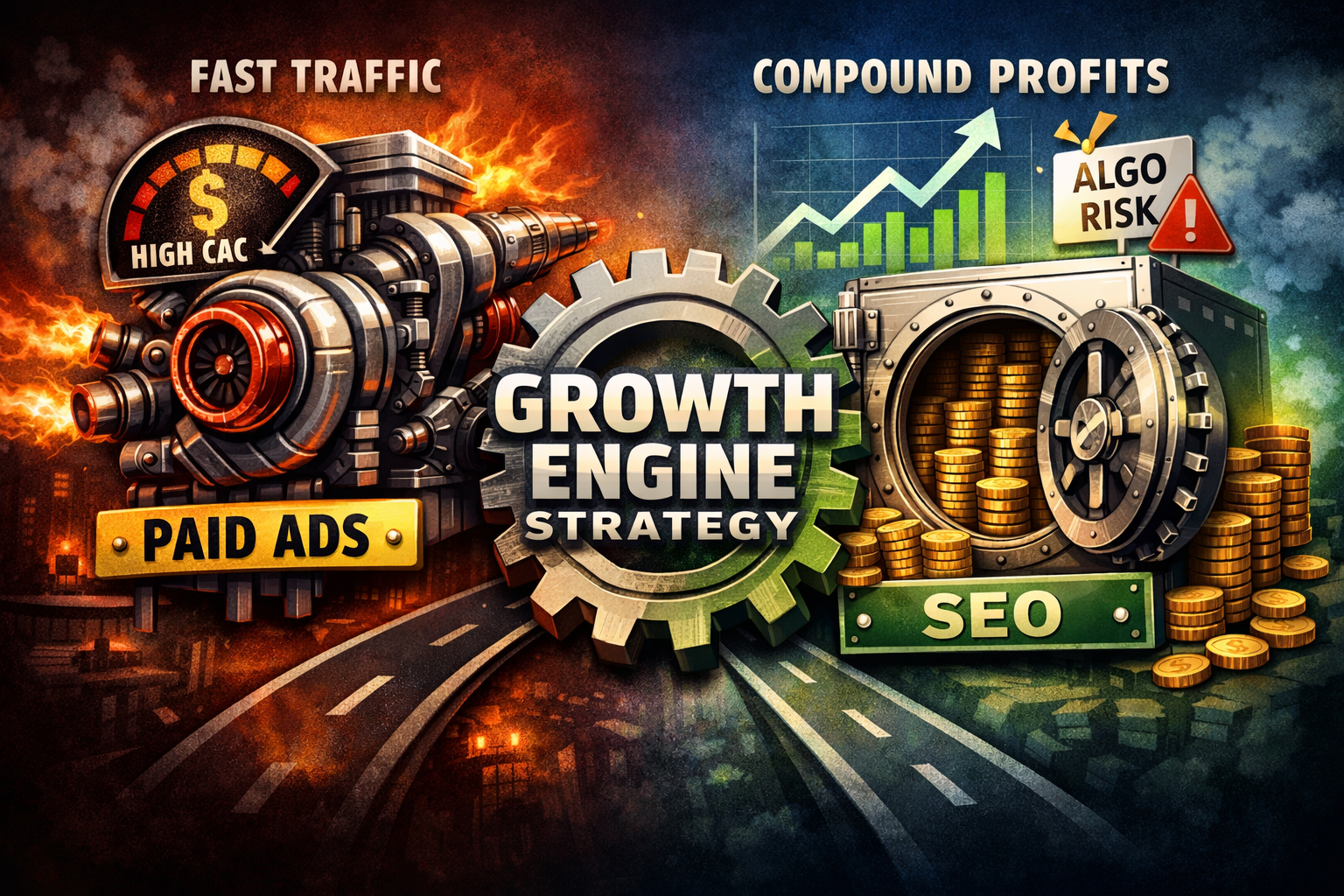
Most businesses don’t have a marketing problem.
They have an engine problem.
They’re trying to use the wrong engine for the wrong job.
The Silent Crisis
A founder opens their ad dashboard.
The numbers look impressive.
- 3,200 clicks this week
- 148 leads
- 22 new customers
Growth.
Momentum.
The machine is running.
But then the finance report arrives.
Customer Acquisition Cost is creeping upward. Margins are shrinking. Every new customer requires another injection of ad spend just to keep the pipeline full.
The engine is loud.
But it burns fuel like a jet.
On the other side of the market, another business is living the opposite nightmare.
Their SEO is working beautifully.
They rank.
Traffic flows in quietly every day. Thousands of visitors. No ad spend required.
But there’s a problem.
They can’t control it.
When sales dip this month, they can’t turn a dial and generate leads tomorrow. They’re stuck waiting for the slow rhythm of search demand and Google’s algorithms.
Their engine is efficient.
But it’s slow to respond.
This is the silent crisis in modern marketing.
Businesses confuse two completely different engines:
- Paid Ads → Operational Engine
- SEO → Profitability Compounder
When you treat them as interchangeable, the system breaks.
The Operational Engine: Why Paid Ads Are Built for Control
Paid advertising is not a “growth strategy.”
It’s an operational tool.
Think of it like a throttle on an engine.
You can turn the dial.
Traffic goes up.
Turn it down.
Traffic slows.
This control is incredibly powerful when you’re trying to answer one question:
Does the market actually want this product?
Paid ads are the fastest feedback loop a business can buy.
You launch a campaign Monday morning.
By Friday you know:
- Which headlines convert
- Which audience responds
- Which offer resonates
- Which product actually sells
That feedback loop is gold.
In operations terms, ads give you real-time telemetry.
Every campaign becomes a test.
Every click becomes data.
And when you find product-market fit, ads allow something that SEO cannot:
Operational Scalability.
If your funnel converts profitably, you can pour more fuel into the engine and grow faster.
More budget → more traffic → more customers.
Simple.
But there’s a catch.
Actually, there are two.
The CAC Tax
Paid ads come with a permanent toll booth.
Every click has a price.
Platforms like Google Ads and Meta are effectively auction houses for attention.
As competitors enter the market, the price rises.
Your Customer Acquisition Cost (CAC) increases.
Your margin shrinks.
And unlike SEO, ad traffic has no memory.
Turn off the budget and the traffic disappears instantly.
That’s why businesses that rely entirely on ads eventually hit a wall.
Their growth engine becomes a fuel dependency.
The machine only runs if you keep feeding it money.
Which brings us to the second engine.
The Profitability Compounder: Why SEO Builds Quiet Wealth
SEO operates on a completely different economic model.
Ads are transactional.
SEO is compounding.
The first click you get from Google might cost thousands of dollars in content creation, optimization, and link building.
But the 1,000th click?
That one is essentially free.
And the 10,000th.
And the 100,000th.
This is where SEO becomes dangerous—in a good way.
Because once rankings stabilize, the Customer Acquisition Cost trends toward zero.
And when CAC drops while revenue stays constant, something magical happens:
Profit explodes.
This is why some companies quietly dominate entire industries.
They built a search moat years earlier.
Competitors who rely only on ads must constantly pay the CAC tax.
The SEO-driven company doesn’t.
But SEO has its own uncomfortable truth.
Algorithm Risk
Google owns the highway.
And they can change the rules anytime.
If your business depends entirely on organic rankings, a major algorithm update can cut your traffic overnight.
It happens more often than people admit.
SEO also suffers from a different operational weakness:
Speed.
You can’t flip a switch and rank tomorrow.
Content takes time to produce.
Pages take time to index.
Authority takes time to build.
In mechanical terms, SEO has inertia.
Once it’s moving, it’s powerful.
But getting it moving is slow.
The Content Half-Life
There’s another concept that separates SEO from ads: content half-life.
Every article, guide, or landing page you publish continues to produce traffic for months—or even years.
Some pieces decay quickly.
Others become permanent assets.
A well-built article can deliver thousands of visitors long after the original marketing budget is forgotten.
Ads stop working the moment you stop paying.
Content keeps working long after you stop writing it.
That’s why SEO behaves more like an investment portfolio than a campaign.
Each piece of content becomes a long-term asset that generates compounding returns.
But here’s the part most businesses miss.
These engines are not competitors.
They’re gears in the same machine.
The Strategic Synthesis: Using Ads to Fund the SEO Moat
The smartest companies don’t choose between ads and SEO.
They stage them.
First comes the Operational Engine.
Ads give you speed.
They help you test offers, messaging, and customer segments.
They reveal which keywords actually convert.
This data is incredibly valuable for SEO.
Because instead of guessing what content might work, you already know.
Your ad campaigns become market research for your organic strategy.
You identify:
- High-converting search terms
- High-value customer problems
- Messaging that triggers action
Then you build SEO assets around those signals.
Now the second engine starts spinning.
As your organic rankings grow, something interesting happens.
Traffic increases.
But ad spending doesn’t have to increase at the same rate.
Your blended Customer Acquisition Cost drops.
Eventually, the economics flip.
The organic traffic becomes the primary growth driver.
Ads remain useful—but now they serve different purposes:
- Testing new offers
- Launching new products
- Filling temporary demand gaps
- Protecting high-value keywords
At this stage, SEO becomes the profitability engine, while ads remain the operational control system.
One drives efficiency.
The other drives speed.
When both engines run together, you get something rare in business:
Strategic Growth.
Why Most Agencies Get This Wrong
Most marketing agencies specialize in one engine.
They either:
- Sell SEO rankings
or - Sell ad management
Both approaches miss the system.
Ranking keywords doesn’t guarantee revenue.
Running ads without a compounding content strategy guarantees rising CAC.
The real job of marketing strategy is engine orchestration.
Some alternative marketing firms—including ours—focus specifically on this synthesis.
We treat marketing like a mechanical system.
Which engine is weak?
Which gear is missing?
Where is the friction?
Because the goal isn’t traffic.
The goal is profitable growth.
And profitable growth only happens when operational scalability and financial efficiency move together.
The Real Question Every Business Should Ask
Most founders ask the wrong marketing question.
They ask:
“Should we invest in SEO or paid ads?”
That’s like asking whether a car should have an engine or a transmission.
The real question is different.
Which engine is currently the bottleneck?
If your pipeline is empty and you need leads tomorrow, the operational engine matters more.
Speed beats efficiency.
If your business is growing but margins are shrinking because ad costs keep rising, the profitability compounder becomes critical.
Efficiency beats speed.
Understanding this difference is what separates marketing spend from growth systems.
And most companies never make that shift.
They keep pouring money into one engine and wondering why the machine struggles to move.
If you’re serious about fixing that, the first step isn’t buying more ads or publishing more blog posts.
It’s diagnosing the system.
Where is the constraint?
Operational flow?
Or financial margin?
That’s exactly what we analyze in our Growth Engine Audit—a deep diagnostic that identifies whether your biggest bottleneck is speed, profitability, or the missing gear between them.
Because the uncomfortable truth is this:
Most businesses aren’t failing because their marketing isn’t working.
They’re failing because their marketing engines were never designed to work together in the first place.
Leave a Reply