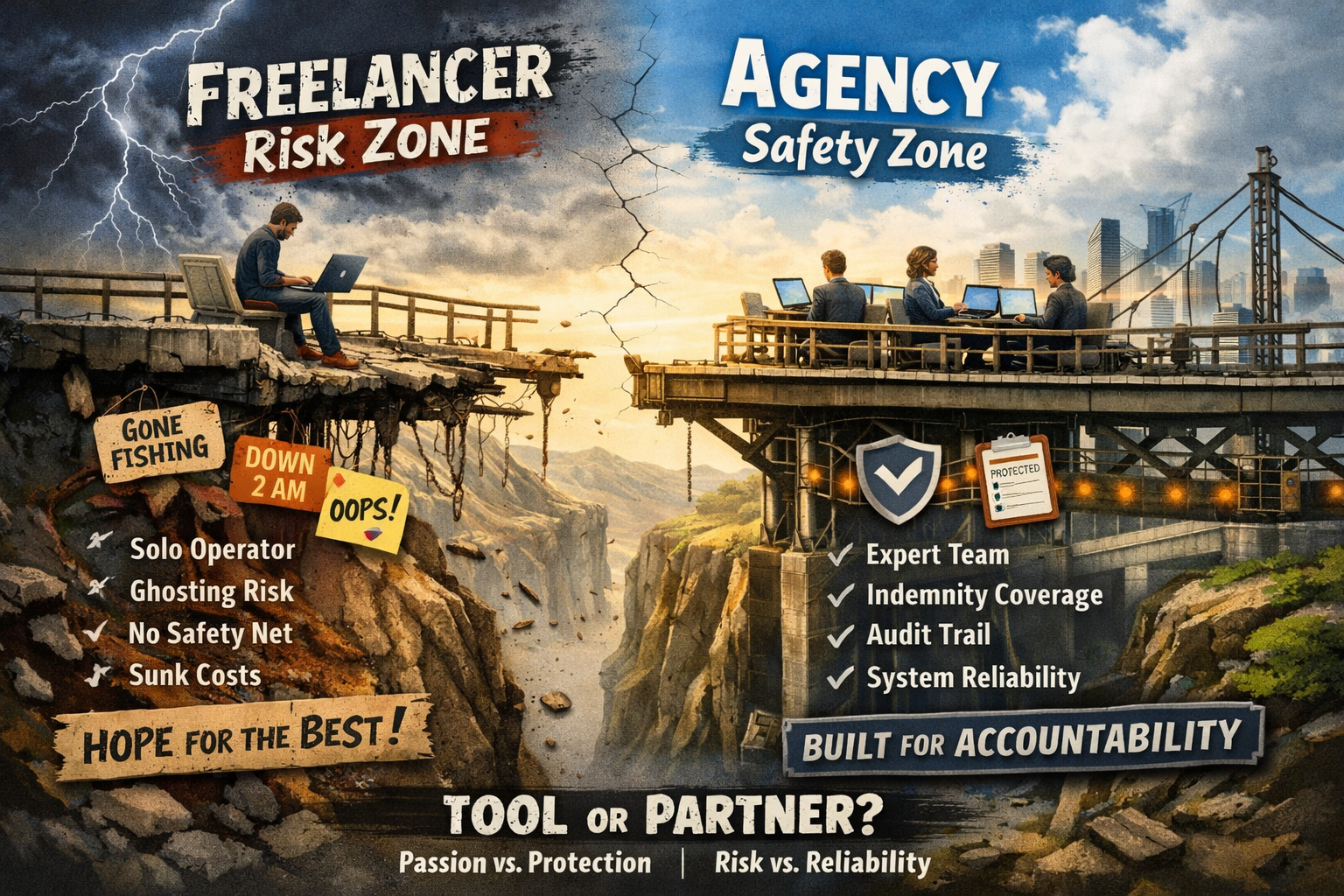
The “Vibe” Fallacy
Every founder has the same story.
You hire a freelancer. The call is great. The portfolio looks sharp. They talk about passion. You talk about vision. It feels like a partnership already.
Slack messages fly back and forth.
“Love this direction.”
“Great energy.”
“Let’s build something amazing.”
For a few weeks, everything feels right.
Then one day the site crashes.
It’s Sunday.
It’s 2:03 AM.
Traffic is still coming in. Paid campaigns are still running. Leads are still clicking… into a broken website.
You send a message.
No response.
You send another.
Still nothing.
Then you remember something you didn’t think about during those great “vibe” calls:
Freelancers sleep.
Freelancers burn out.
Freelancers disappear.
And suddenly the “cheap” hire becomes a very expensive lesson.
This is the quiet reality behind the Agency vs. Freelancer for SEO debate. Most companies believe they are saving money.
What they’re actually doing is self-insuring against catastrophic failure.
And most of them don’t realize it until the midnight crash.
The Single Point of Failure
The Illusion of Personal Responsibility
Freelancers sell a compelling story.
“I care more than an agency.”
“I’ll treat your project like my own.”
“I’m not a big company with bureaucracy.”
And sometimes that’s true.
But caring is not a system.
It’s a mood.
Businesses don’t run on moods. They run on reliability.
This is where the illusion appears.
Clients believe hiring someone who “cares deeply” reduces risk.
In reality, it concentrates risk into a single fragile point: one human being.
We call this The Freelancer Bottleneck.
One person holds:
- Your SEO architecture
- Your analytics stack
- Your CMS permissions
- Your content pipeline
- Your production timeline
One person.
If that person gets sick, overloaded, distracted, or simply decides to take a week off the grid, the entire system stops.
Not slows down.
Stops.
This is why Content Marketing Scalability almost always fails under a single operator model. Content marketing is not just writing articles. It’s a chain of processes:
- Keyword strategy
- Content briefs
- Writing
- Editing
- SEO optimization
- Internal linking
- Publishing
- Distribution
- Performance tracking
Break one link and the entire chain stalls.
Freelancers don’t fail because they’re incompetent.
They fail because humans have capacity limits.
Agencies build around those limits.
Systems don’t get tired.
Redundancy doesn’t burn out.
And that’s the real difference between personal responsibility and organizational accountability.
Section 2: Skin in the Game vs. Ghosting
Let’s talk about the part no one likes discussing.
Liability.
Freelancers operate in a low-liability environment.
If something goes wrong, the most common outcome is simple:
An apology.
Maybe a refund.
Sometimes not even that.
Because realistically, what are you going to do?
Sue a freelancer in another country over a broken site or leaked credentials?
Legal action costs more than the damage.
So the loss becomes a sunk cost.
Your only real option is to rebuild.
This is why Professional Indemnity for Marketing exists.
Serious agencies carry it for a reason.
When an agency touches your website, your data infrastructure, or your marketing systems, they assume real risk.
If something breaks, the agency cannot simply vanish.
They have:
- A legal entity
- A brand reputation
- Insurance exposure
- Long-term clients
- A public footprint
Freelancers can disappear.
Agencies cannot.
That’s the quiet truth behind the so-called “agency premium.”
You’re not paying for overhead.
You’re paying for institutional accountability.
It’s the same reason corporations hire consulting firms instead of solo contractors for high-stakes work.
The deliverables matter.
But the liability structure matters more.
If something goes wrong, someone with real assets is responsible.
Not just someone with a Gmail address.
SOPs vs. “Good Days”
Freelancers often produce brilliant work.
Some of the best marketers in the world are independent operators.
But brilliance has a flaw.
It’s inconsistent.
A freelancer has good days.
Great days.
Occasionally even genius days.
But they also have:
Bad days.
Exhausted days.
Distracted days.
That variability creates a dangerous problem for businesses.
Your marketing results begin to depend on someone’s daily energy level.
Agencies solve this with something far less glamorous.
SOPs.
Standard Operating Procedures.
SOPs don’t aim for brilliance.
They aim for consistency.
At a well-run agency, every piece of content, every SEO change, every campaign goes through repeatable systems:
- Documented workflows
- Review layers
- QA checkpoints
- Approval structures
- Post-launch monitoring
The goal is not peak performance.
The goal is something far more valuable.
The Quality Floor.
The Quality Floor means:
Even on the worst day, the system still delivers acceptable results.
Nothing breaks.
Nothing disappears.
Nothing falls through the cracks.
And over time, that consistency compounds.
This is why our SOPs at Alternative Marketing are built for redundancy—not just results.
Because businesses don’t scale on heroic moments.
They scale on reliable systems.
The Midnight Crash
Let’s go back to that scenario.
Sunday.
2 AM.
Your website crashes.
This isn’t hypothetical. It happens constantly.
Plugins update incorrectly.
Servers fail.
Deployments break.
Tracking scripts conflict.
Someone has to respond.
Now ask the uncomfortable question:
Who answers the phone?
The freelancer?
Maybe.
If they’re awake.
If they see the message.
If they haven’t taken a weekend off.
An agency environment looks very different.
Incidents trigger internal escalation.
Slack alerts fire.
Monitoring systems notify the team.
Someone investigates.
Someone patches.
Someone reports back.
This is the difference between a human dependency and a business system.
Freelancers work on availability.
Agencies operate on coverage.
And coverage is what keeps businesses alive during the midnight crashes.
The Audit Trail: Why Mistakes Matter
Mistakes happen everywhere.
Freelancers make them.
Agencies make them.
Even in-house teams make them.
The difference isn’t the mistake.
It’s what happens after.
In freelancer relationships, errors usually end with a sentence.
“Sorry about that.”
Then everyone moves on.
But apologies are not scalable.
You can’t build a company on apologies.
Agencies approach mistakes differently.
Every failure becomes an audit trail.
What broke?
Why did it break?
Which step failed?
Which safeguard was missing?
How do we prevent it permanently?
That root-cause analysis feeds back into the system.
A mistake becomes a data point.
The SOP evolves.
The system improves.
The next client benefits from the previous client’s mistake.
This is how real organizations build Risk Mitigation in Digital Marketing.
Not by hoping nothing goes wrong.
But by designing systems that learn when it does.
The Real Cost Equation
Agencies are more expensive.
Let’s be honest about that.
A freelancer might cost $2,000 a month.
An agency might cost $8,000.
At first glance, the math looks obvious.
But that comparison ignores something critical.
Risk exposure.
A broken migration.
A lost analytics setup.
A corrupted CMS deployment.
A misconfigured SEO redirect.
Any one of those mistakes can cost tens of thousands in lost revenue.
Sometimes more.
Suddenly the “cheap” option looks less like savings and more like uninsured risk.
The agency premium isn’t about luxury.
It’s about operational insurance.
The Real Choice
The debate is often framed incorrectly.
Agency vs freelancer.
Cost vs savings.
Flexibility vs structure.
But that framing misses the real decision businesses are making.
You’re not choosing between two vendors.
You’re choosing between two risk models.
One model says:
“Trust the individual.”
The other says:
“Trust the system.”
One depends on passion.
The other depends on accountability.
One breaks quietly.
The other documents everything.
So the real question isn’t whether an agency costs more.
Of course it does.
The real question is much simpler:
Are you buying a tool?
Or are you buying a partner?
If you’re tired of managing freelancers, chasing updates, and hoping nothing breaks…
Maybe it’s time to stop managing vibes and start managing systems.
If that conversation sounds overdue, start here.
Because businesses don’t grow on passion alone.
They grow on accountability.
Leave a Reply