
We killed a 3,200-word article last quarter.
Not because it was wrong. Not because it was poorly written.
But because it didn’t deserve to exist.
It ranked. It got impressions. It even pulled a trickle of traffic.
And yet—when we looked closer—it had zero impact.
No backlinks. No brand searches. No conversions. No authority lift.
It was content. Not an asset.
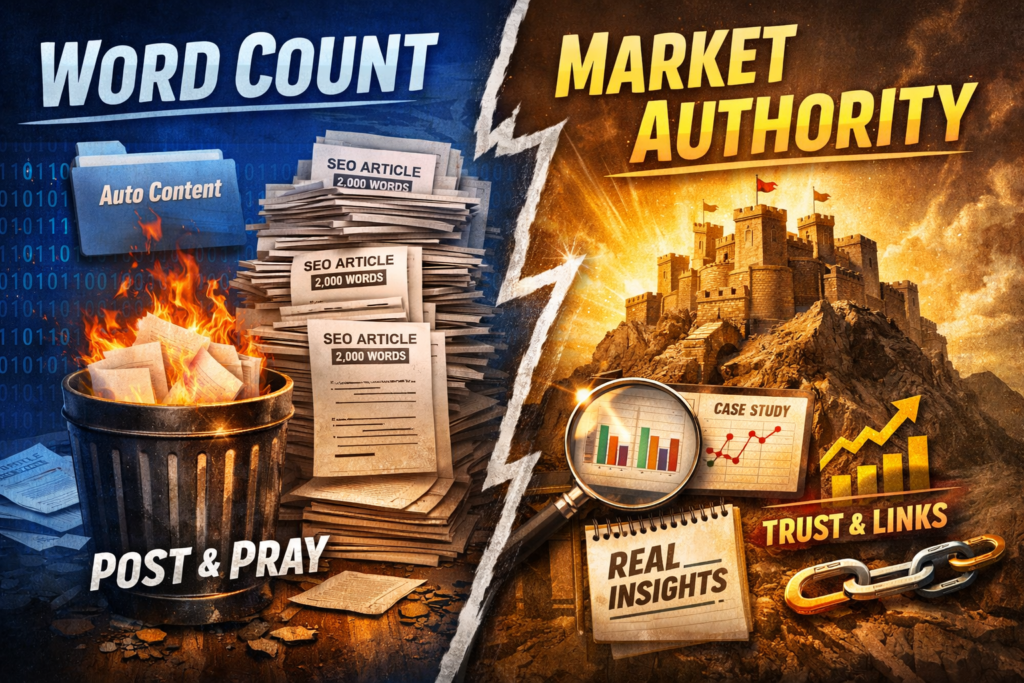
That’s when the realization hit (again): word count is not a strategy—it’s a distraction.
The Efficiency Trap: When “More Content” Becomes Negative ROI
There’s a quiet lie circulating in SEO circles:
“If you publish enough content, something will work.”
This used to be partially true. Now it’s operationally stupid.
Commodity Content vs. Digital Equity
AI has collapsed the cost of production to near zero. That means:
- Anyone can generate 50 articles a week
- Everyone is targeting the same keywords
- Most content is structurally identical
What you’re left with is a flood of commodity content—interchangeable, disposable, and strategically useless.
We call this the post-and-pray model:
- Publish at scale
- Hope something ranks
- Move on
The problem? It creates zero Digital Equity.
Digital Equity is the compounding value of:
- Branded search demand
- Backlinks you didn’t beg for
- Mentions in conversations you didn’t initiate
- Trust signals that persist beyond rankings
Commodity content doesn’t compound. It decays.
And worse—it trains your organization to optimize for volume instead of leverage.
If your content can be replicated in 30 seconds, it has no strategic value.
If your current strategy feels like a treadmill, not a flywheel—you’re measuring the wrong output.
The Strategic Goal: Build a Moat by Saying What Others Won’t
Most SEO strategies fail for a simple reason:
They target safe questions.
- “What is X?”
- “Benefits of Y”
- “How to do Z”
These are not opportunities. They are battlegrounds—crowded, predictable, and algorithmically saturated.
The Real Game: Answer the Questions Competitors Avoid
Market authority is built by doing something uncomfortable:
Answering the questions your competitors are too lazy—or too afraid—to touch.
These usually fall into three categories:
1. The “Unprofitable Truth”
Content that risks reducing short-term conversions but builds long-term trust.
Example:
- “When NOT to invest in [your service]”
- “Why most [industry solutions] fail”
2. The “Operational Reality”
Not theory. Not best practices. But what actually happens in the field.
Example:
- Real campaign breakdowns
- Internal decision frameworks
- Failure post-mortems
This is where most companies hesitate—because it exposes how things really work.
3. The “Contrarian Thesis”
A direct challenge to industry orthodoxy.
Example:
- “SEO content length is a useless metric”
- “Top-of-funnel traffic is overrated”
These pieces don’t just rank. They get shared, debated, and cited.
That’s the moat.
If your content never risks disagreement, it will never earn authority.
The Blog Post as an Asset: Designing for Zero-Click Reality
Here’s the uncomfortable truth:
A large percentage of your audience will never click your article.
They will:
- Read the SERP snippet
- Skim AI overviews
- Extract just enough information to move on
If your content only delivers value after the click, you’ve already lost.
The New Requirement: Value at First Impression
Your content must:
- Answer the core question in a single, decisive statement
- Structure information for instant extraction
- Provide clarity faster than competitors
This isn’t about giving everything away.
It’s about owning the answer, even if the user never visits your site.
Authority is built when your name becomes synonymous with the answer—not just the page.
Silo Architecture: Turning Articles Into Systems
A single blog post is fragile.
A structured content system is durable.
Instead of writing isolated articles, build content silos:
- A core thesis page (e.g., “Why Word Count Doesn’t Matter”)
- Supporting articles:
- Case studies
- Tactical breakdowns
- Contrarian arguments
- Data-backed validations
Each piece reinforces the others.
The result:
- Stronger internal linking
- Clear topical authority
- Higher crawl efficiency
- Better user retention
This is how you turn content from output into infrastructure.
If your blog reads like a collection instead of a system, you’re leaving authority on the table.
Authority Building (E-E-A-T): The “Boots on the Ground” Advantage
Let’s be blunt.
Google doesn’t trust content anymore.
It evaluates evidence.
The Shift from Information to Proof
Anyone can explain a concept.
Very few can prove they’ve executed it.
That’s where E-E-A-T becomes real—not as a guideline, but as a filter.
What “Boots on the Ground” Actually Looks Like
1. Real Case Studies
Not generic success stories. Actual breakdowns:
- What was attempted
- What failed
- What changed
- What worked
2. Unique Visual Proof
Screenshots, dashboards, internal tools.
Not stock images. Not diagrams.
Proof.
3. Veteran Vetting
Content reviewed (and challenged) by people who’ve done the work.
Not just writers. Operators.
If your content hasn’t been questioned by someone experienced, it’s probably wrong—or irrelevant.
The Hidden Multiplier: Trust Compounds Faster Than Traffic
A single authoritative piece can:
- Attract backlinks organically
- Increase branded search
- Improve conversion rates across the funnel
- Position your company as a category leader
Meanwhile, 50 average articles will:
- Compete with each other
- Dilute your brand
- Waste crawl budget
- Produce negligible returns
This is not a content problem. It’s a capital allocation problem.
The Brutal Reality: Most Content Strategies Are Misaligned
Let’s call it out directly.
- Publishing 2,000+ words “because SEO” → outdated
- Chasing keyword volume without intent → lazy
- Measuring success by traffic alone → misleading
These aren’t just ineffective tactics.
They are organizational blind spots.
They create the illusion of progress.
But they don’t build authority.
What Actually Works: A High-Leverage Content Framework
If the goal is Market Authority, the strategy shifts:
1. Fewer Pieces. Higher Stakes.
Every article must justify its existence.
If it doesn’t:
- Add a new perspective
- Provide original data
- Challenge existing beliefs
It doesn’t get published.
2. Depth Over Length
Depth is:
- Specificity
- Insight density
- Practical applicability
Length is just formatting.
3. Distribution as Strategy
Authority isn’t built in isolation.
Each piece should be:
- Repurposed
- Discussed
- Debated
If no one engages with your content, it doesn’t matter how “optimized” it is.
4. Continuous Refinement
High-authority content is never “done.”
It evolves:
- New data
- Updated insights
- Improved clarity
If your content is published once and forgotten, you’re treating assets like expenses.
Common Agreement: The Path to Market Authority
Let’s strip away the noise and agree on what actually matters.
- Word count is easy to measure—and easy to manipulate
- Traffic is visible—but often misleading
- Volume feels productive—but rarely compounds
Market Authority, on the other hand:
- Is hard to fake
- Takes time to build
- Compounds across every channel
The path forward is simple—but not easy:
- Stop producing content that can be replicated instantly
- Start answering questions others avoid
- Design every piece to deliver value before the click
- Back every claim with real-world proof
- Treat your blog as a system, not a library
Do this consistently, and something shifts.
You stop competing on keywords.
You start owning conversations.
And when that happens, rankings become a byproduct—not the objective.
That’s the difference between content that fills space…
and content that builds a market position.