
A Campaign That Should Have Worked (But Didn’t)
Last month, a brand published 120 pieces of content in 30 days.
Blogs. LinkedIn posts. Twitter threads. Even a few polished videos.
Everything was “right.”
SEO-optimized. Clean formatting. Zero grammar mistakes.
It looked like a machine built by people who read all the playbooks.
Traffic barely moved.
No spike. No lift. No compounding effect.
Just… flat.
That’s when it clicked—not for them, but for us watching from the outside:
They weren’t competing on content anymore.
They were competing for attention.
And they were losing.
Why Content by the Pound is Killing Your ROI
We’ve hit a breaking point.
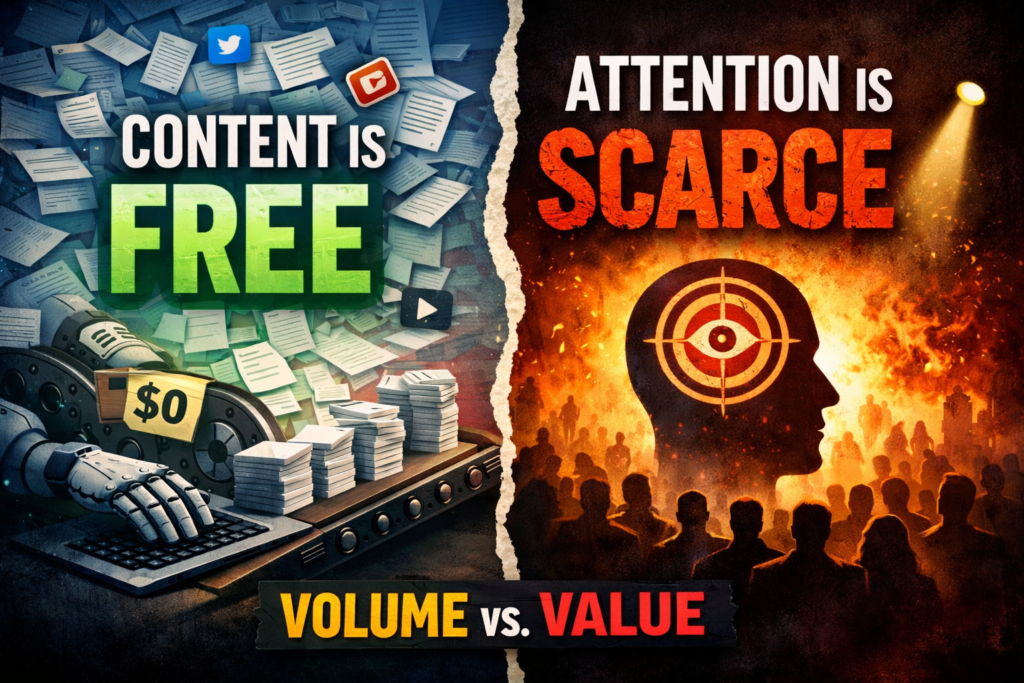
The marginal cost of production—the cost of creating one more piece of content—has collapsed to near zero. AI didn’t just improve productivity. It nuked scarcity.
And when something becomes abundant, it becomes worthless.
Not metaphorically. Economically.
You can now generate:
- 50 blog posts before lunch
- 100 social posts before dinner
- A full “content strategy” before your coffee gets cold
So what happens?
Everyone does.
Which means your beautifully optimized article is now competing with a thousand identical ones. Same structure. Same tone. Same “value.”
Different logo.
This is the Great Content Commoditization Event. And most brands are still playing the old game—more volume, more keywords, more output.
That strategy used to work.
Now it’s a tax.
Distribution is the Only Real Asset Left
Here’s the shift most teams haven’t internalized yet:
Creation used to be the bottleneck. Now distribution is.
Read that again.
You don’t win because you can create content.
You win because you can get people to actually see it.
That’s the Great Inversion.
The advantage has flipped from:
- “Can you produce enough?” → to → “Can you reach anyone who cares?”
This is where the idea of a distribution moat comes in.
If you don’t own:
- An email list
- A loyal audience
- A community that actually pays attention
…then you’re renting visibility.
And rented attention is fragile.
Algorithms change. Reach collapses. Costs spike. You’re back to zero.
Meanwhile, brands that own distribution don’t play that game. They compound.
Every email sent strengthens the asset.
Every post reinforces familiarity.
Every interaction deepens trust.
Content fills the pipeline.
Distribution owns it.
⚡ Mid-Point Reality Check
Most companies don’t have a content problem.
They have a distribution problem they’re disguising with more content.
If you’re not sure where you actually stand, this is the moment to pause and ask:
Who sees what we publish—and why?
If that question feels fuzzy, it’s worth auditing your current distribution channels before creating anything else.
Why “Perfect” Content Gets Ignored
There’s another layer to this.
Even when your content does get seen… it often gets ignored.
Why?
Because it feels like everything else.
AI has created a strange new dynamic:
Content quality has gone up.
Trust has gone down.
We call this the Trust Tax.
The more “perfect” your content looks—polished, structured, optimized—the more it signals something else:
“This was easy to produce.”
And if it was easy to produce, it’s easy to ignore.
People don’t engage with perfection anymore.
They engage with:
- Perspective
- Stakes
- Signal
In other words—something that feels earned.
The brands winning right now aren’t the ones publishing the most.
They’re the ones saying something that:
- Not everyone agrees with
- Not everyone can replicate
- Not everyone is willing to say
That’s what cuts through.
Not polish.
Positioning.
From Content Factories to Psychological Positioning
This is where most agencies break.
They’re still structured around deliverables:
- X blog posts per month
- Y social posts per week
- Z videos per quarter
That model made sense when production was scarce.
Now it’s obsolete.
Because clients don’t need more content.
They need:
- A reason to be noticed
- A reason to be remembered
- A reason to be chosen
That’s not execution. That’s psychological positioning.
It’s the difference between:
- Writing content → and → engineering perception
- Publishing ideas → and → owning a narrative
- Creating assets → and → shaping demand
This is the bridge.
And most agencies haven’t crossed it yet.
⚡ The Strategic Shift
If your agency—or your internal team—is still selling deliverables, you’re competing with tools.
That’s a race you will lose.
The shift is toward result-based agency models:
- Not “we produce content”
- But “we drive attention, trust, and conversion”
If you’re serious about making that transition, the first step is simple:
Stop measuring output.
Start measuring outcomes.
And if you need help making that shift—from deliverables to results—that’s exactly the kind of transformation worth having a conversation about.
Attention Arbitrage: The Only Remaining Edge
So if content is free and trust is fragile… where’s the edge?
It’s here: Attention Arbitrage.
The idea is simple:
Find undervalued attention.
Capture it before others do.
Compound it over time.
But in practice, it’s hard.
Because it requires:
- Seeing where attention is moving, not where it is
- Acting before it’s obvious
- Committing before there’s proof
This is why most brands miss it.
They optimize for efficiency.
Attention arbitrage rewards conviction.
Examples?
- Building an email list when everyone chases social
- Going deep on a niche while others go broad
- Saying something uncomfortable while others stay safe
It’s asymmetric.
And that’s the point.
The New Alpha: Agencies Must Become Media Houses or Die Trying
Let’s be blunt.
The old agency model is dying.
Not slowly. Structurally.
If your value is tied to producing content, you’re already being replaced.
The new alpha looks different.
An agency today must function as one of two things:
1. A Media House
You don’t just create content.
You:
- Build audiences
- Own distribution
- Control reach
You think in terms of subscribers, not impressions.
2. A Strategic Consultancy
You don’t just execute.
You:
- Define positioning
- Shape narratives
- Engineer demand
You sit upstream from content—not downstream of it.
The best agencies?
They do both.
They own attention and they know how to direct it.
If You Can’t Guarantee Attention, You’re Guessing
Here’s the uncomfortable truth most won’t say out loud:
Content without attention is just noise.
And noise doesn’t convert.
If your current strategy can’t answer this question—
“Can we reliably get the right eyes on this?”
—then you don’t have a marketing system.
You have a content habit.
And habits don’t scale.
They stall.
If you’re producing more but seeing less… it’s not a content issue.
It’s an attention problem.
And if you can’t guarantee eyes on the page, it’s time to rethink the model entirely.
That’s the conversation we have every day.
Content is free.
Attention is scarce.
The brands that understand the difference will own the next decade.