
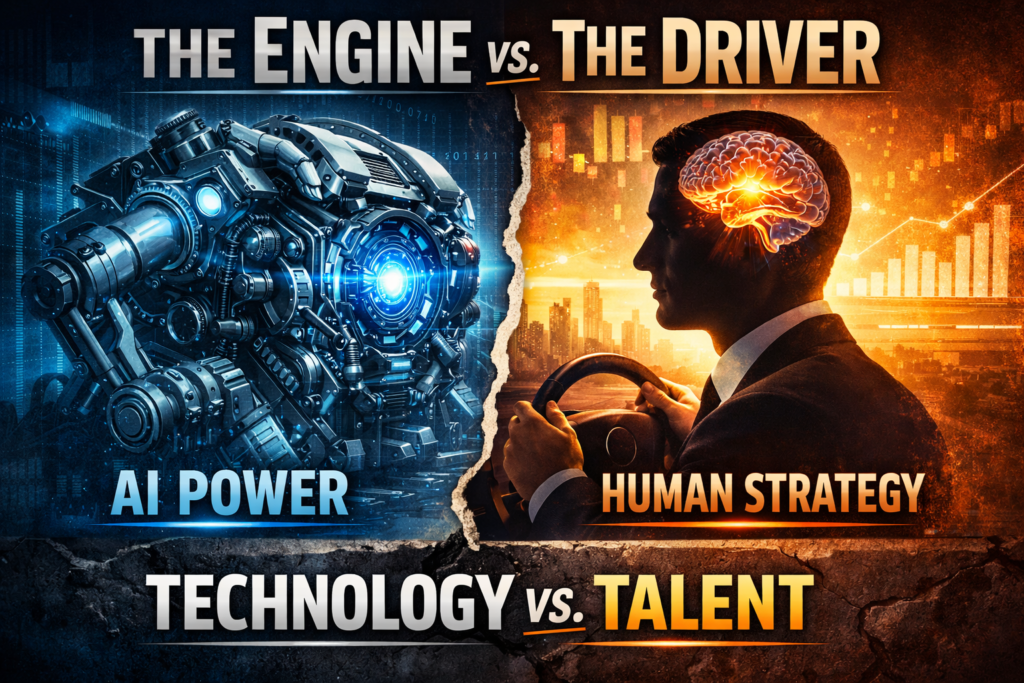
The False Binary That’s Costing You Growth
Let me tell you a story you’ve probably seen play out in some version.
A mid-sized SaaS company—smart team, ambitious roadmap—decides to “cut the middleman.” Agencies are expensive, they say. Why pay retainers when we have AI now?
So they go all-in.
They buy the best tools. Spin up a stack. Train the team on prompts. Within weeks, they’re producing content at 10x their previous velocity. Blog posts. Landing pages. Email sequences. Even technical SEO audits—automated.
At first, it feels like a breakthrough.
Traffic ticks up. Output explodes. The CFO is smiling.
Then something strange happens.
- Rankings plateau.
- Conversion rates stall.
- Messaging starts to feel… interchangeable.
Six months in, they hit a wall. Not a technical wall—a strategic one.
They weren’t lacking horsepower.
They were missing a driver.
This is the false binary of 2026:
Agency vs. AI. Human vs. machine.
It’s the wrong debate.
Because the real advantage isn’t choosing between them.
It’s knowing how to combine them.
Understanding What AI Actually Does (and Doesn’t)
Let’s strip away the hype.
AI is not magic. It’s not creative genius. It’s not strategy.
AI is an engine.
And like any engine, it does three things exceptionally well:
1. Velocity
AI collapses time.
What used to take days—keyword clustering, content drafting, competitor analysis—now happens in minutes.
This changes the economics of execution. You can:
- Test more ideas
- Publish faster
- Iterate without friction
But speed alone isn’t a strategy. It’s just acceleration.
And if you’re accelerating in the wrong direction… you get lost faster.
2. Pattern Recognition
AI is trained on massive datasets. It recognizes patterns in language, structure, and search behavior.
That’s why it’s excellent at:
- Structuring SEO-friendly content
- Identifying common ranking signals
- Mimicking high-performing formats
But here’s the catch:
AI doesn’t understand why those patterns work. It only knows that they do.
So what happens?
You get content that looks right… but feels hollow.
Technically sound. Strategically empty.
3. Friction Removal
AI removes operational bottlenecks.
No more blank pages. No more slow research cycles. No more dependency on a single writer’s bandwidth.
This is where AI SEO Strategy becomes powerful—when used to eliminate friction in execution.
But again, removing friction doesn’t define direction.
It just makes movement easier.
The Hard Truth
AI is a commodity.
Everyone has access to it. Everyone is using it.
So if your strategy is “use AI,” you don’t have a strategy.
You have table stakes.
The competitive advantage doesn’t come from the engine.
It comes from the driver.
The Part You Can’t Automate
Here’s where most conversations break down.
People assume the “human layer” is about editing grammar or tweaking tone.
That’s not it.
The real value of a Human-Led AI approach lies in three things AI cannot replicate:
1. Judgment & Ethics
AI operates on probability.
It predicts the next best word, the most likely structure, the statistically “correct” answer.
But brands don’t operate on probability.
They operate on nuance.
- What shouldn’t we say, even if it ranks?
- Where do we draw the line on messaging?
- How do we navigate sensitive positioning in a crowded market?
AI doesn’t understand brand risk. It doesn’t feel reputational weight.
A human does.
And in high-stakes industries—finance, healthcare, enterprise SaaS—that judgment is everything.
2. Strategic Intent
This is the big one.
AI can help you rank.
But it doesn’t know why you should.
There’s a difference between:
- Ranking for traffic
vs. - Ranking for revenue
A real strategy asks:
- Does this keyword attract buyers or browsers?
- Where does this page sit in the funnel?
- How does this content support Conversion Rate Optimization, not just visibility?
Without that layer, you get what we see everywhere now:
High traffic. Low impact.
This is where most solo AI users fail. They optimize for outputs, not outcomes.
3. Accountability (The “Neck on the Line” Factor)
AI has no skin in the game.
If a campaign fails, it doesn’t care.
An agency—at least a good one—does.
There’s a psychological shift when someone’s reputation is tied to your results.
- They challenge assumptions
- They push back on bad ideas
- They own the outcome
That’s not something you can prompt.
That’s something you commit to.
Key Takeaway:
AI generates options.
Humans make decisions.
And in business, decisions are where value is created—or destroyed.
The Value Add: Why “Better” Beats “Cheaper” Every Time
Let’s address the elephant in the room.
Cost.
The initial appeal of going AI-only is obvious: it’s cheaper.
No retainers. No contracts. Just tools.
But here’s what most companies miss:
Cost reduction is not the same as value creation.
The real question isn’t “How much did we save?”
It’s “What did we leave on the table?”
The Real ROI Equation
When you combine AI with human strategy, something interesting happens.
You don’t just move faster.
You learn faster.
And that changes your entire Content Marketing ROI model.
1. Agility: Faster Testing Cycles
With AI as the engine, agencies can:
- Launch multiple content variations quickly
- Test headlines, angles, and offers in parallel
- Iterate based on real performance data
This compresses feedback loops.
What used to take months now takes weeks—or days.
2. Innovation: More Shots on Goal
Most companies under-test.
Not because they lack ideas—but because execution is expensive.
AI removes that constraint.
But without a strategic driver, you just create more average content.
With the right agency, you:
- Explore unconventional angles
- Test contrarian positioning
- Build differentiated narratives
This is where real growth happens—not in best practices, but in breakthroughs.
3. Compounding Gains
When strategy meets speed, results compound.
- Better targeting → higher conversion rates
- Faster iteration → improved messaging
- Continuous learning → sustained growth
This is how AI SEO Strategy becomes a profit engine—not just a traffic machine.
This is exactly why we’ve built internal SOPs that force every AI output through a strategic filter. Execution is automated—but decisions are human.
The Rise of the Augmented Agency
The future isn’t AI replacing agencies.
And it’s not agencies ignoring AI.
It’s something more interesting.
The rise of the Augmented Agency.
What Does That Actually Mean?
It means:
- AI handles execution at scale
- Humans define strategy, direction, and standards
- Systems connect the two seamlessly
Think of it like this:
- The engine provides power
- The driver provides direction
- The system ensures control
Remove any one of these, and performance collapses.
Why This Model Wins
Because it aligns with reality.
Business isn’t a content problem.
It’s a decision problem.
And the companies that win in 2026 are the ones that:
- Use AI to move faster
- Use humans to move smarter
If your current setup feels like it’s producing more content but not more results, that’s usually a signal—not of effort, but of direction.
Stop Asking the Wrong Question
“Should we use AI or an agency?”
That question is outdated.
The better question is:
“Who is driving the engine?”
Because in a world where everyone has access to the same tools, the difference isn’t technology.
It’s judgment.
It’s intent.
It’s accountability.
Final Thought
AI will keep getting better.
Faster. Smarter. More capable.
But it will never own outcomes.
People do.
And the organizations that understand this—who build systems where AI is the engine and humans are the driver—will outperform those chasing shortcuts.
Every time.
Key Takeaways
- AI is a commodity — its value lies in how you apply it, not in access itself.
- Human-led strategy is the differentiator — especially in high-stakes, competitive markets.
- Speed without direction is dangerous — AI amplifies both good and bad strategy.
- The best results come from hybrid models — where execution is automated, but decisions are human.
- ROI comes from outcomes, not outputs — traffic means nothing without conversion.
Ready to Put a Real Driver Behind Your Growth?
If you’re serious about turning AI from a cost-saving tool into a revenue-generating system, we should talk.
Our approach is simple:
Human-led strategy. AI-powered execution. Relentless focus on outcomes.
👉 Book a discovery call with our Alternative Marketing team and let’s map out where your current engine is underperforming—and how to fix it.