
You don’t have a prompt problem.
You have a strategy problem.
And no amount of clever phrasing, token tweaking, or “act as a world-class marketer” incantations will fix it.
That belief—that you can prompt your way to a market-leading position—is the most expensive illusion in modern marketing. It feels efficient. It feels scalable. It feels like leverage.
It isn’t.
It’s a shortcut to perfectly executed irrelevance.
The “Magic Button” Myth
Let’s call it what it is: the Magic Button Myth.
Push the right sequence of words into a model, and out comes high-converting content. Blog posts. Landing pages. Ad copy. All optimized, all aligned, all ready to perform.
Except… perform against what?
Most teams are optimizing for output. Volume. Speed. Cost per article.
Words per week becomes the KPI.
That’s not marketing strategy. That’s manufacturing.
And worse—it’s manufacturing without a blueprint.
The uncomfortable truth is this: prompt engineering is a tactic pretending to be a strategy. It lives downstream. It executes. It refines. It accelerates.
But it does not decide.
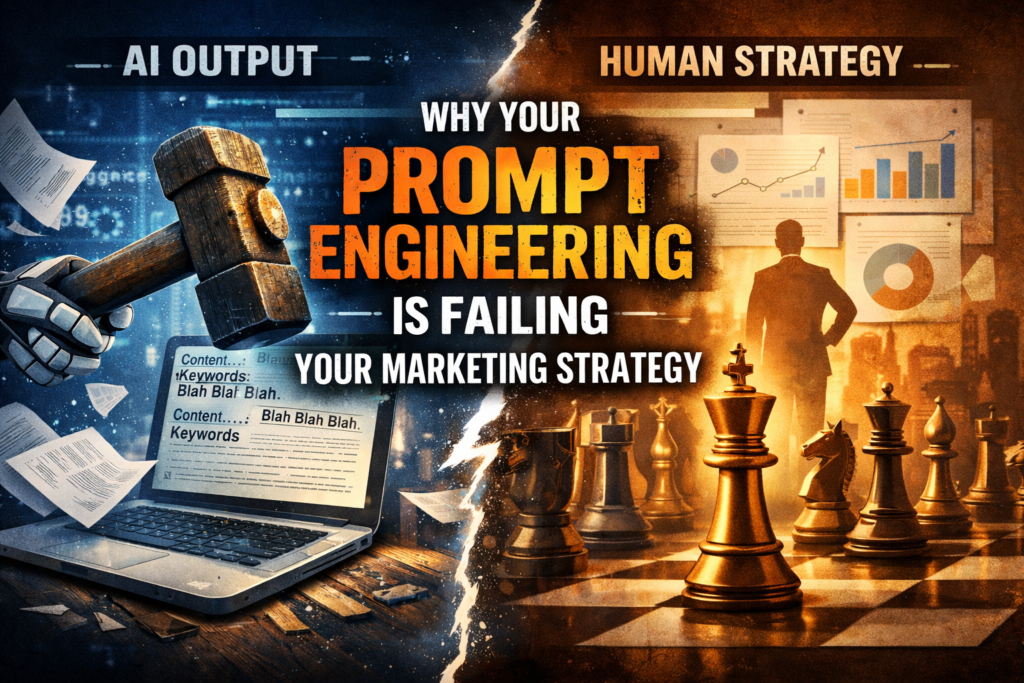
This is the core misunderstanding behind the current obsession with prompt engineering. People are polishing the hammer, assuming it will design the house.
It won’t.
Because the real leverage in marketing isn’t in how efficiently you produce content. It’s in whether that content is pointed at the right problem, for the right audience, with the right tension.
That’s the difference between marketing strategy vs tactics.
And most teams are playing the wrong game.
A $50K Saving That Cost $500K
Let me give you a familiar story.
A mid-sized SaaS company—let’s call them Atlas—decides to “modernize” their content engine.
They cut their agency. Save $50,000 a quarter.
They build an internal AI workflow. Hire a prompt engineer. Spin up a content calendar. Publish 40 articles a month.
Traffic ticks up. Slightly.
Costs go down. Significantly.
On paper, it looks like a win.
Six months later, pipeline is down 30%.
Market share starts slipping. Quietly at first. Then obviously.
Why?
Because their content—while technically correct, grammatically clean, and SEO-optimized—was strategically hollow.
They weren’t saying anything distinct.
They weren’t responding to the real shifts in their category.
They weren’t addressing the objections that actually stalled deals.
They had optimized the expression of ideas… without ever upgrading the ideas themselves.
Meanwhile, a competitor repositioned. Subtly. No massive rebrand. Just a sharper narrative, clearer stakes, and content that spoke directly to buyer anxiety.
Atlas didn’t see it.
A prompt can’t detect a whispered pivot in the market.
A prompt doesn’t sit in sales calls.
A prompt doesn’t feel the tension in a deal that almost closed—but didn’t.
So Atlas kept publishing.
And slowly, predictably, they became irrelevant at scale.
That $50K saving?
It cost them half a million in lost opportunity.
The Moat You Can’t Prompt
Here’s where most AI-first marketing strategies collapse:
They assume that intelligence is the same as context.
It’s not.
A model can generate. It can remix. It can even sound insightful.
But it cannot see your business the way a human operator can.
It cannot answer questions like:
- How much risk is your CEO actually willing to take?
- Which competitor is about to pivot—and hasn’t announced it yet?
- What are your sales team’s real objections, not the sanitized CRM notes?
- Where are you over-positioned… or worse, invisible?
This is the Human/Agency Moat.
Not execution.
Judgment.
Taste.
Context.
Accountability.
A prompt doesn’t get fired when the strategy fails.
An agency does. A CMO does. A founder does.
That pressure changes how decisions are made.
And it’s precisely what creates the gap between content that exists… and content that moves markets.
Strategy First. Always.
Let’s simplify this.
Good strategy, in its cleanest form, follows three steps:
1. Diagnosis
What’s actually going on?
Not the surface-level metrics. The underlying constraint.
Is your problem awareness? Positioning? Category confusion? Misaligned incentives?
Most AI-driven workflows skip this entirely. They assume the problem is “we need more content.”
That’s rarely true.
2. Guiding Policy
What’s your approach to solving it?
This is where trade-offs live.
Who are you not targeting?
What narrative are you choosing to own?
What are you willing to sacrifice to be distinct?
A prompt cannot make trade-offs. It averages. It blends. It hedges.
Which is exactly why AI-generated content often feels… safe.
And forgettable.
3. Coherent Action
Now—and only now—do tactics come into play.
Content. SEO. Distribution. Messaging.
This is where prompt engineering actually belongs.
Inside execution.
Not above it.
Not instead of it.
The prompt is the last mile, not the starting point.
If your current content feels like an echo chamber, you’re missing a diagnosis, not a better prompt.
The Illusion of Strategic SEO
There’s another layer to this.
What most teams call “SEO strategy” today is just structured production.
Keyword clusters. Topic maps. Internal linking.
Important? Yes.
Sufficient? Not even close.
Real strategic SEO architecture isn’t about covering keywords.
It’s about owning narratives.
It’s about aligning search intent with business intent.
It’s about deciding which conversations you want to dominate—and which ones you’re deliberately ignoring.
AI can help you scale coverage.
But it cannot decide what deserves to be covered in the first place.
That requires taste.
And taste is expensive.
The Augmented Agency Model
So where does this leave us?
Not in a rejection of AI.
But in a rejection of how it’s currently being used.
The future isn’t AI vs humans.
It’s the augmented agency model.
A split of responsibilities:
Humans (or Agencies):
- Define positioning
- Run diagnosis
- Set guiding policy
- Interpret market signals
- Make trade-offs
- Own outcomes
AI:
- Draft content
- Expand variations
- Accelerate production
- Handle repetitive execution
This is the leverage point.
Not replacing thinking—but amplifying it.
Because once the strategy is sound, AI becomes a force multiplier.
Without it?
It’s just a faster way to publish mediocrity.
The Real Risk No One Talks About
Here’s the part most teams underestimate:
AI doesn’t just scale output.
It scales your current level of thinking.
If your strategy is weak, AI will amplify that weakness.
If your positioning is generic, AI will industrialize that genericness.
If your understanding of the market is shallow, AI will make you confidently wrong—at scale.
That’s the risk.
Not that AI will replace marketers.
But that it will expose them.
Don’t Confuse the Hammer with the Blueprints
Prompt engineering is useful.
Powerful, even.
But only in the right place in the stack.
Treat it like strategy, and you’ll end up like Atlas—efficient, consistent, and quietly losing.
Treat it like execution, and it becomes what it should be:
A tool.
Nothing more.
Nothing less.
Don’t confuse the hammer with the blueprints. If you’re ready to invest in the thinking before the doing, let’s talk about building an SEO and Content Strategy that AI can’t replicate.