
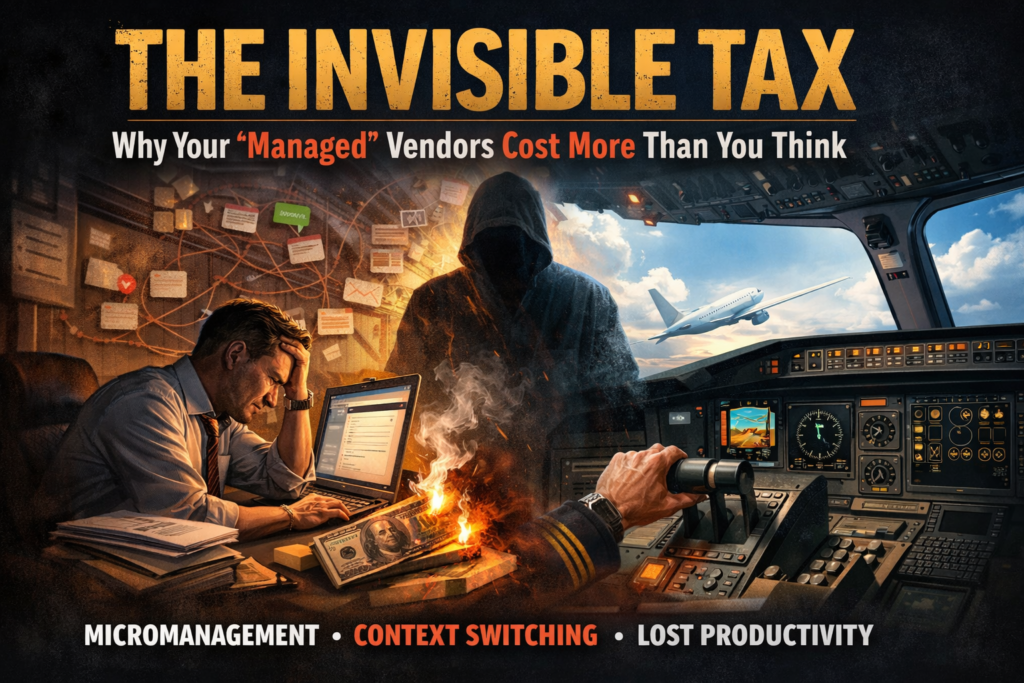
It’s 9:07 PM.
Your laptop is still open. Slack is still blinking. And you—technically the CEO—are chasing a status update from someone you’re paying to “handle it.”
You type:
“Hey, just checking… any update on the SEO fixes?”
Three dots appear. Then disappear.
Five minutes later:
“Yep, working on it.”
No details. No timeline. No clarity.
You sigh. Open another tab. Pull up the task list. Start digging through Google Docs and Jira threads trying to reconstruct what’s actually happening.
Congratulations.
You’ve just stepped into the Shadow Task Trap.
And it’s quietly draining more money from your business than any vendor invoice ever will.
The Shadow Task Trap
Most founders believe vendor costs are simple math:
Vendor Cost=Monthly RetainerVendor\ Cost = Monthly\ RetainerVendor Cost=Monthly Retainer
That’s the illusion.
The real equation includes something far more expensive: your attention.
Because when vendors aren’t truly managed, something strange happens.
The work doesn’t disappear.
It migrates upward.
Instead of execution happening inside the vendor team, the coordination—clarification, monitoring, decision-making—moves into your brain.
Suddenly, your day looks like this:
- Reviewing SEO tickets
- Clarifying content briefs
- Following up on deadlines
- Approving micro-decisions
- Re-explaining strategy
You become the unpaid project manager of people you’re already paying.
This is the invisible tax.
And it compounds.
The Founder as Traffic Controller
Imagine two versions of the same business.
In the first scenario, the founder acts like an airport traffic controller.
Every task passes through them.
- “Can you prioritize this?”
- “Is this the right keyword cluster?”
- “Should we publish this page?”
- “Is the schema markup correct?”
Nothing moves without their signal.
At first, it feels like control.
In reality, it’s operational gravity.
The more vendors you add—SEO agencies, developers, content writers—the worse it gets.
You stop flying the plane.
You start directing runway lights.
Meanwhile, the second scenario looks very different.
The founder becomes the pilot, not the traffic controller.
They define altitude and destination.
The team handles navigation.
This only works when someone inside the system owns professional project management.
Because execution without orchestration is chaos.
The Anatomy of Reclaimed Time
Professional management isn’t administrative overhead.
It’s defensive infrastructure.
Think about something like Technical SEO Infrastructure.
If your site’s crawlability breaks, rankings collapse. Traffic disappears.
Nobody debates whether technical SEO matters.
But strangely, founders debate project management constantly.
Yet the operational principle is identical.
Both systems prevent failure before it happens.
A competent project manager does three things most founders underestimate:
1. Risk Pre-emption
Most operational problems aren’t surprises.
They’re missed signals.
- A developer misunderstood the SEO requirement
- A writer misinterpreted the keyword intent
- A technical dependency wasn’t identified early
Without professional oversight, those issues surface weeks later, after work is already done.
That’s how you end up with the dreaded message:
“Hey, quick thing—we might need to redo this.”
Professional management stops that before it starts.
Not through heroics.
Through systems.
2. Decision Compression
Founders often believe they must approve everything.
But the real goal is decision compression.
Instead of reviewing 20 granular choices, you review 2 strategic ones.
For example, in a well-managed Content Marketing Lifecycle, you should only be asked questions like:
- “Do we focus the next content cluster on revenue keywords or authority keywords?”
- “Should we expand the semantic topic map for product pages or comparison pages?”
Not:
- “Should we use H2 or H3 here?”
- “Is this keyword density okay?”
If you’re making tactical decisions, something upstream is broken.
3. Execution Containment
When things go wrong—and they always do—professional management contains the damage.
Instead of chaos spreading across Slack threads and email chains, the issue gets resolved inside the system.
You hear about it after it’s solved.
This is what operational maturity looks like.
And it produces something founders rarely experience:
Silence.
The Hard Math of Context Switching
Let’s talk about the real cost.
Every interruption carries a recovery penalty.
Research in productivity science consistently shows that it takes roughly 23 minutes to regain full focus after switching tasks.
The math looks like this:
TimeLoss=23 minutes×InterruptionsTime_{Loss} = 23 \text{ minutes} \times InterruptionsTimeLoss=23 minutes×Interruptions
Now imagine your day.
Slack messages from vendors.
Quick approvals.
Status check-ins.
Clarification questions.
Let’s say that happens eight times.
TimeLoss=23×8=184 minutesTime_{Loss} = 23 \times 8 = 184 \text{ minutes}TimeLoss=23×8=184 minutes
That’s over three hours lost to context switching.
Every single day.
Now multiply that by your effective hourly value as a founder.
For many CEOs, that number is easily $300–$1000 per hour when you factor in opportunity cost.
Suddenly the real cost equation becomes:
True Vendor Cost=Retainer+Founder Time LossTrue\ Vendor\ Cost = Retainer + Founder\ Time\ LossTrue Vendor Cost=Retainer+Founder Time Loss
And that second variable is almost always larger than the first.
The Decision Fatigue Spiral
There’s another hidden cost: decision fatigue.
Every micro-decision consumes cognitive energy.
Approve a blog title.
Approve a keyword list.
Approve a technical change.
Approve internal links.
Individually, these choices feel trivial.
But together, they create mental drag.
By the time you reach the decisions that actually matter—market positioning, product strategy, hiring—you’re already depleted.
Professional management fixes this by absorbing operational decisions.
Instead of asking:
“What do you think?”
The system brings you a recommendation:
“Here’s the approach. Here’s why. Approve or adjust.”
Your job becomes direction, not supervision.
Pattern Interrupt #1
If you’re still the engine mechanic for your SEO strategy, you’re idling.
Let us handle the silence.
The “Done-Done” Standard
There’s a phrase high-performing teams use:
Done-done.
Not almost done.
Not done pending feedback.
Not done once the client reviews it.
Done-done means production ready.
Most vendor relationships fail here.
Work is technically completed—but not truly finished.
Which creates the dreaded cycle:
- Vendor delivers work
- Client reviews it
- Client finds issues
- Vendor revises
- Repeat
Welcome to the Feedback Loop from Hell.
The deeper the loop, the more founder time gets consumed.
Professional management breaks this loop through structured QA.
Before anything reaches you, it passes internal checks:
- Technical validation
- Content optimization review
- Semantic content alignment
- Strategic consistency
By the time it reaches your desk, you’re not editing.
You’re approving.
Pattern Interrupt #2
If your vendors still need you to connect the dots, you’re not outsourcing.
You’re supervising.
There’s a difference.
The ROI of Outsourcing (Done Correctly)
True outsourcing isn’t about reducing labor costs.
It’s about removing operational load.
The ROI equation looks like this:
ROI=(Founder Time Reclaimed×Strategic Output)−Vendor CostROI = (Founder\ Time\ Reclaimed \times Strategic\ Output) – Vendor\ CostROI=(Founder Time Reclaimed×Strategic Output)−Vendor Cost
The moment your vendors require daily management, that equation flips negative.
Because the most expensive employee in your company becomes… you.
And your highest-value activity—thinking—is replaced by coordination.
Why Most Vendors Fail Here
Most agencies promise execution.
Few promise management infrastructure.
Why?
Because real project management is expensive.
It requires:
- Experienced operators
- Clear process architecture
- Technical oversight
- Quality assurance layers
Cheaper vendors skip this layer entirely.
Which shifts the burden to the client.
In other words:
You become the project manager they didn’t hire.
Pattern Interrupt #3
If you’re reviewing Slack threads to figure out what your SEO team is doing…
You’re paying twice.
Once for the vendor.
Once with your time.
Buying Back the Future
At its core, professional management isn’t about organization.
It’s about time sovereignty.
The best founders protect their attention the way elite athletes protect their bodies.
They know that scattered attention kills performance.
When systems run properly, something remarkable happens.
You stop thinking about them.
Your SEO pipeline runs.
Your Semantic Content Optimization compounds.
Your Technical SEO Infrastructure evolves quietly in the background.
And your brain finally returns to the problems that actually grow the business.
Product.
Vision.
Strategy.
Markets.
The work only founders can do.
The Silence Test
Here’s a simple diagnostic.
Ask yourself this question:
How often do you think about your SEO operations?
If the answer is daily, something is wrong.
If the answer is weekly, something is still leaking.
If the answer is almost never, the system is working.
Because the ultimate measure of operational excellence isn’t activity.
It’s silence.
And silence, in business, is one of the purest forms of ROI.
Silence is ROI.