
The Quiet Flatline
About six months ago, we spoke with a founder who had a familiar story.
He ran a small but growing B2B services company. Smart operator. Good margins. Solid product. A year earlier, he decided it was finally time to “do SEO.”
So he hired an agency.
The pitch was straightforward:
- $500/month
- “Full-service SEO”
- Monthly reports
- Keyword optimization
- Blog posts
Reasonable price. Predictable cost. Sounded professional.
Fast forward 12 months.
Traffic? Flat.
Leads from organic? Basically unchanged.
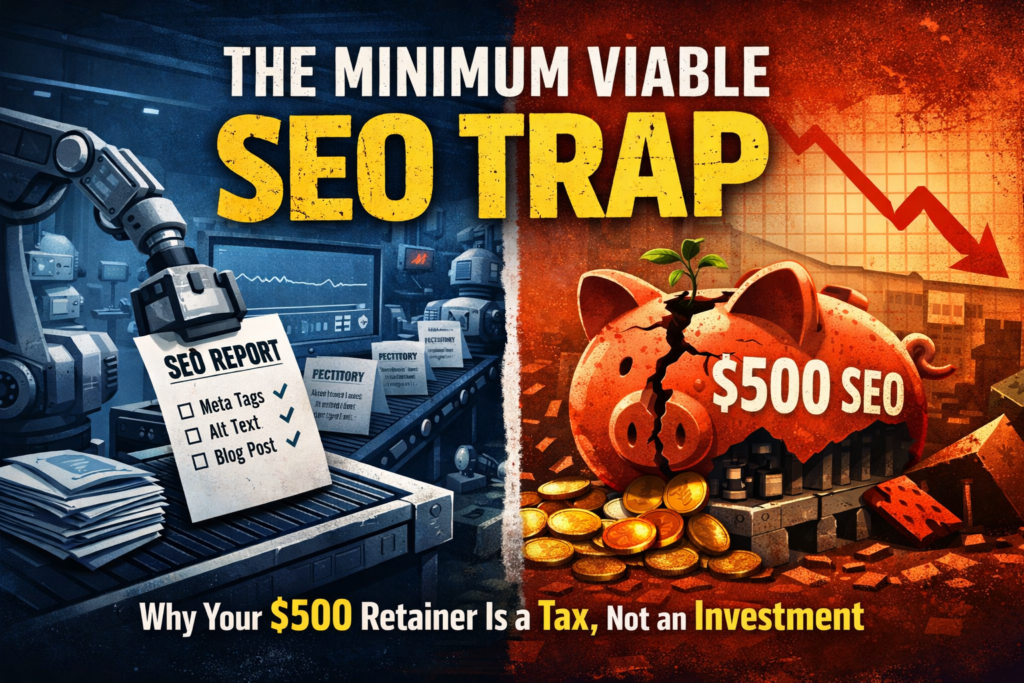
But every month, like clockwork, the agency delivered a report:
- Meta tags optimized ✔
- Image alt text updated ✔
- Blog post published ✔
- Rankings “being monitored” ✔
Everything looked busy.
But nothing actually moved.
When we audited the account, the problem became obvious within 15 minutes.
What he had purchased wasn’t SEO.
He had purchased Automated Mediocrity.
And the uncomfortable truth is this:
At $500/month, real SEO is mathematically impossible.
Not difficult.
Not inefficient.
Impossible.
The Mathematical Impossibility
Let’s talk about something the SEO industry rarely acknowledges:
The Labor Floor.
Every service business has one.
It’s the minimum cost required to produce meaningful work.
SEO isn’t immune to physics.
Let’s break down a typical $500/month SEO retainer.
The Agency Math
Out of that $500:
- Sales commission
- Account management
- Reporting tools
- SEO software
- Taxes
- Overhead
- Profit margin
By the time the dust settles, the actual labor budget left for your website might look like this:
- $150–$200 of real work
Now assume a junior SEO specialist costs the agency about $50/hour loaded.
What does that buy you?
3–4 hours of work per month.
Three.
Hours.
Per.
Month.
For context, a proper SEO sprint often requires:
- Technical auditing
- Content strategy
- Competitive analysis
- Authority building
- Content production
- Link acquisition
- UX adjustments
- Data analysis
That’s not a three-hour job.
That’s a multi-disciplinary system.
Which leads to a hard truth most agencies won’t say out loud:
At sub-$1k retainers, SEO becomes a hollow product.
It exists because it’s easy to sell—not because it works.
The Assembly Line Problem
To make low retainers profitable, agencies must scale through volume.
Which creates an SEO factory model:
One strategist → 30–50 clients.
Work becomes templated.
Processes become automated.
Customization disappears.
You end up with what we call:
Checklist SEO.
Tasks like:
- Updating title tags
- Adding alt text
- Publishing generic blog posts
- Running automated audits
These actions look productive.
But they rarely move rankings.
Because modern SEO isn’t about tweaking pages.
It’s about building authority systems.
And systems take time.
Key Takeaway
Cheap SEO doesn’t fail because of incompetence.
It fails because of physics.
You cannot build search authority on a three-hour monthly budget.
The Maintenance Loop
Most low-cost SEO programs follow a predictable pattern.
We call it The Maintenance Loop.
It looks productive.
It produces reports.
But it doesn’t produce growth.
Let’s look at the common cycle.
Month 1–2: Surface Fixes
The agency runs automated audits and delivers quick wins:
- Meta descriptions updated
- Broken links fixed
- Alt text added
- Page titles tweaked
These are good hygiene practices.
But they’re table stakes, not strategy.
Imagine hiring a construction company to build a skyscraper…
…and they spend the first six months polishing the lobby floor.
That’s what surface SEO fixes are like.
They improve polish.
They don’t build structure.
Month 3–6: Content Noise
Next comes the blog pipeline.
Usually:
- 4 articles/month
- 800–1,000 words
- $50–$100 production budget
In 2015, that might have worked.
In 2026, it’s mostly noise.
Why?
Because search engines are now flooded with AI-generated content.
Millions of articles are being published every week.
Which means the competitive threshold for ranking has exploded.
Publishing cheap blog posts today is like throwing paper airplanes into a hurricane.
They don’t travel far.
Month 7–12: Reporting Theater
When results don’t materialize, reporting gets… creative.
You’ll see charts like:
- “Keyword visibility increased 8%”
- “Impressions improved”
- “Ranking fluctuations detected”
These metrics create the illusion of progress.
But the only numbers that matter are:
- Qualified traffic
- Revenue from search
- Lead pipeline impact
Everything else is noise.
Tinkering vs Growing
This is the fundamental difference between low-cost SEO and real SEO.
Tinkering
- Adjusting metadata
- Publishing generic blogs
- Running automated reports
Growing
- Building topical authority
- Creating defensible content assets
- Engineering link velocity
- Improving user intent match
- Expanding content clusters
One is maintenance.
The other is growth engineering.
And growth engineering requires time, talent, and capital.
Key Takeaway
SEO growth comes from structural work, not cosmetic tweaks.
Cheap retainers can only afford cosmetics.
The ROI Shift
Now let’s reframe the conversation.
Most business owners evaluate SEO like this:
“Can I afford $1,500/month?”
That’s the wrong question.
The real question is:
“What yield does this investment generate?”
Because price alone is meaningless without return.
The $500 Trap
Let’s compare two hypothetical SEO programs.
Option A — Cheap SEO
- Cost: $500/month
- Annual spend: $6,000
- Revenue impact: $0
Return on investment:
0x
You didn’t invest.
You paid a marketing tax.
Option B — Strategic SEO
- Cost: $1,500/month
- Annual spend: $18,000
- Revenue generated: $90,000
Return on investment:
5x
Now which one is cheaper?
The $500 plan felt safe.
But the $1,500 plan produced actual growth.
This is the difference between:
Cost thinking
vs
Yield thinking
SEO Is an Asset Class
The best way to understand SEO is to think of it like real estate development.
Cheap SEO is like buying a random empty lot and hoping something valuable appears.
Strategic SEO is like developing property in a prime location:
- You build infrastructure
- You create long-term equity
- You generate recurring returns
When done correctly, organic search becomes:
- Your largest acquisition channel
- Your lowest CAC source
- Your most defensible growth engine
But assets require investment.
There’s no shortcut.
The AI Search Reality
There’s another reason cheap SEO is dying.
AI-saturated search results.
Search engines are now filtering through:
- AI blog farms
- Automated affiliate sites
- Mass-produced content
Which means quality thresholds are rising rapidly.
Today, ranking requires:
- Deeper expertise
- Original insights
- Stronger authority signals
- Better content architecture
Cheap blog factories can’t compete here.
They produce volume, not authority.
And search engines increasingly reward the latter.
Key Takeaway
In the AI era, mediocre content doesn’t rank.
It disappears.
The Alternative: Outcome-Based SEO
At our agency, we don’t sell checklists.
We sell outcomes.
That means we approach SEO like an engineering problem:
- Traffic opportunity mapping
- Content authority architecture
- High-leverage asset creation
- Authority acceleration (links & PR)
- Conversion yield optimization
Every step ties directly to pipeline growth, not vanity metrics.
Because SEO should not be a monthly utility bill.
It should be a growth engine.
If Your SEO Feels Like Busywork…
You’re probably stuck in the Minimum Viable SEO trap.
And if you’ve been paying for it long enough, you’ve likely already seen the symptoms:
- Traffic plateau
- Blog content nobody reads
- Reports full of vanity metrics
- Rankings that never convert
If that sounds familiar, it might be time to ask a different question.
What would SEO look like if it were designed to generate revenue—not tasks?
Key Takeaways
- Sub-$1k SEO retainers rarely provide enough labor to generate meaningful results.
- Surface-level optimization creates activity, not growth.
- Cheap blog content is increasingly invisible in AI-saturated search results.
- SEO should be evaluated by yield, not monthly cost.
- Real SEO builds long-term digital assets that compound over time.
Final Thought
SEO is not magic.
It’s not hacks.
And it’s definitely not a checklist of monthly tasks.
It’s closer to building infrastructure.
Roads. Bridges. Foundations.
Those things take planning, expertise, and investment.
But once they exist, everything moves faster.
Traffic flows.
Commerce grows.
Markets expand.
The question isn’t whether SEO works.
The question is whether you’re investing enough to build something real.
If you’re tired of Automated Mediocrity, we should talk.
Most agencies sell you tasks.
We sell outcomes.
And if you’re curious what your organic growth potential actually looks like, we’re happy to run a brutally honest SEO yield analysis for your business.