
The $1,000 Screw
A client once complained about a $1,000 invoice for ten minutes of work.
The consultant listened patiently, then replied:
“You aren’t paying for the ten minutes.
You’re paying for the ten years it took me to know which screw to turn.”
That story circulates in almost every professional industry—from engineering to medicine to software.
And yet most businesses still insist on paying experts by the hour.
Which creates a strange contradiction.
You say you want expertise.
But you insist on paying for time.
Those are not the same thing.
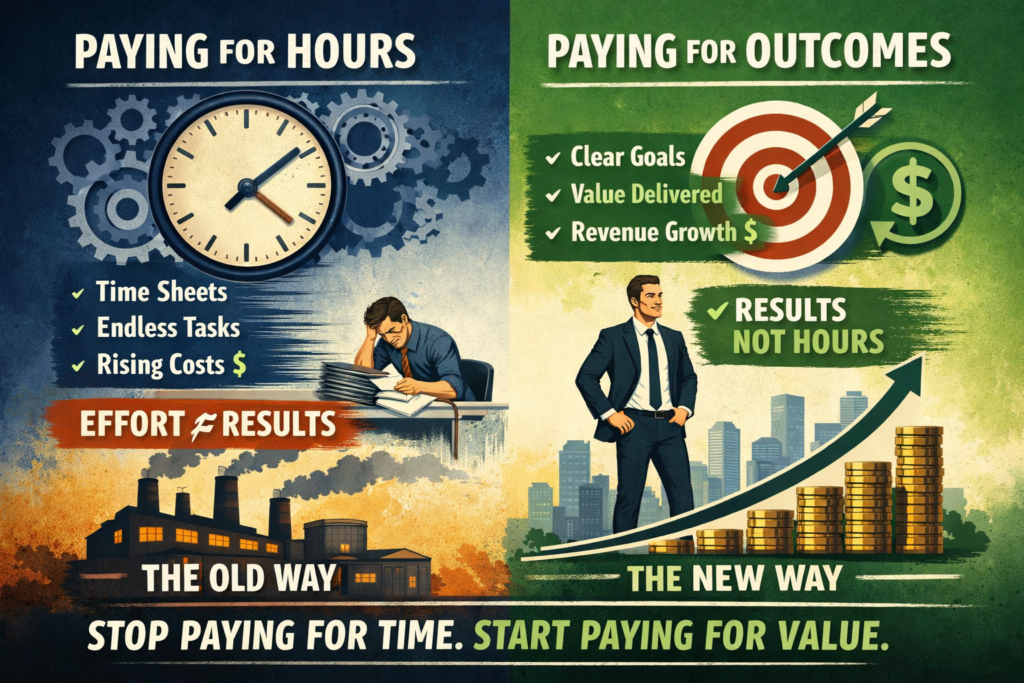
Hourly billing is a relic of the Industrial Age Clock—a system designed for factory labor, not knowledge work.
Factories measured output in hours because the work was predictable and repetitive.
Expert work is the opposite.
It’s nonlinear.
It’s diagnostic.
And when done correctly, it’s often surprisingly fast.
Which leads to a counter-intuitive truth:
The better the expert, the fewer hours they need.
And that’s exactly why hourly billing punishes expertise.
The Industrial Age Clock Is Still Running the Show
Hourly billing didn’t come from strategy firms or marketing agencies.
It came from factories.
In the industrial economy, work followed a simple equation:
Time × Labor = Output
More hours meant more production.
But knowledge work doesn’t follow that equation.
The best SEO strategist might find the problem in five minutes.
The average one might spend three weeks “auditing.”
Under hourly billing, the inefficient strategist earns more.
That’s not a flaw in the system.
That is the system.
Counter-Intuitive Truth
Hourly billing rewards effort, not effectiveness.
Which means clients end up paying for activity instead of outcomes.
Consider how this plays out in marketing.
An agency bills:
- 20 hours of keyword research
- 15 hours of content writing
- 10 hours of reporting
On paper, everything looks productive.
But none of those things are the goal.
The goal is revenue.
And the Industrial Age Clock doesn’t measure revenue.
It measures time.
The Perverse Incentive Nobody Talks About
Let’s say you hire an expert who can solve your problem in two hours.
Under hourly billing, they make less money.
Now imagine another consultant who takes twenty hours to reach the same result.
They make ten times more.
Same outcome.
Completely different reward structure.
This creates a quiet but powerful conflict of interest.
If I’m faster, I earn less.
If I’m inefficient, I earn more.
No one admits this openly.
But the incentive is there.
And incentives shape behavior.
Counter-Intuitive Truth
Efficiency becomes a financial liability under hourly billing.
That’s why the smartest service businesses eventually abandon time-based pricing.
They move toward value-based pricing and outcome-based contracts.
Not because it sounds sophisticated.
Because it aligns incentives.
When the expert is paid for results, both sides want the same thing.
Faster results.
Better results.
Bigger results.
That’s the foundation of the Results-Based Economy.
Stop Selling Tasks. Start Selling Outcomes.
Most agencies sell activities.
They talk about:
- Blog posts per month
- Keywords tracked
- Pages optimized
- Hours logged
But clients don’t actually want any of those things.
They want outcomes.
Not “content production.”
They want organic lead generation.
Not “UX improvements.”
They want a high-converting checkout flow.
Not “technical SEO.”
They want revenue from search.
Counter-Intuitive Truth
The client doesn’t care how the engine works. They care if the car moves.
When services are framed around tasks, the conversation stays tactical.
When they’re framed around outcomes, the conversation becomes strategic.
For example:
Instead of selling:
“10 blog posts per month.”
You sell:
“A scalable SEO content strategy designed to produce qualified inbound leads.”
Instead of:
“Landing page design.”
You sell:
“A conversion-optimized checkout flow designed to increase purchase completion.”
That shift changes everything.
It transforms a vendor relationship into a partnership.
And it’s the only way to have a meaningful conversation about B2B marketing ROI.
Why Most Agencies Avoid Outcome-Based Pricing
Here’s the uncomfortable truth.
Most agencies don’t avoid outcome-based contracts because they’re risky.
They avoid them because they expose mediocrity.
If your work doesn’t produce measurable outcomes, results-based pricing becomes dangerous.
So agencies retreat to safety.
Hours.
Deliverables.
Reports.
The illusion of progress.
Counter-Intuitive Truth
Hourly billing protects agencies from accountability.
Which is why outcome-driven models are still rare in marketing.
They require something uncomfortable.
Confidence.
Confidence that your performance marketing strategy actually works.
Confidence that your SEO content strategy produces measurable growth.
Confidence that you understand the mechanics of scaling a service business through demand generation.
Most agencies don’t operate with that level of clarity.
We do.
That’s why our model at Alternative Marketing looks different.
We don’t sell hours.
We sell outcomes.
The Discovery Phase: Stop Estimating. Start Diagnosing.
Here’s another reason hourly billing persists.
Clients ask for estimates.
“How many hours will this take?”
But that question assumes something dangerous.
That the expert already understands the problem.
In reality, most complex business problems require diagnosis first.
Think about medicine.
A surgeon doesn’t say:
“Heart surgery takes roughly 17 hours.”
They diagnose the patient.
Then they determine the procedure.
Counter-Intuitive Truth
The most valuable part of expertise happens before the work begins.
That’s why the shift away from hourly billing starts with a different process.
Not estimation.
Diagnosis.
Instead of asking:
“How many hours will SEO take?”
You ask:
“What’s actually preventing organic growth?”
Sometimes the answer is content.
Sometimes it’s site architecture.
Sometimes it’s positioning.
Sometimes it’s a broken funnel.
Without diagnosis, agencies guess.
And guesses become hourly projects.
Diagnosis turns marketing into a system.
The Certainty Fee: Why Fixed Pricing Transfers Risk
Many clients assume fixed pricing benefits the agency.
In reality, it shifts risk.
Under hourly billing, the client carries the uncertainty.
If a project runs longer than expected, the client pays more.
Under fixed pricing, the agency carries that risk.
If the project requires more work than anticipated, the agency absorbs the cost.
Which is why fixed pricing often includes a certainty premium.
You’re not just paying for the work.
You’re paying for predictability.
Counter-Intuitive Truth
Certainty is one of the most valuable commodities in business.
When budgets are predictable, companies make faster decisions.
When outcomes are defined, strategies become measurable.
That’s why outcome-based pricing is becoming common in:
- Performance marketing
- Growth consulting
- Revenue operations
- Enterprise SEO
It transforms marketing from a cost center into an investment.
The Scope Guardrail (How Outcome Pricing Actually Works)
Outcome-based contracts aren’t vague promises.
They require clear boundaries.
Think of them as scope guardrails.
These define what success means and what inputs are required.
Typical guardrails include:
Defined Outcome
- Increase organic lead generation by X%
- Improve checkout conversion rate by X%
Client Responsibilities
- Access to analytics data
- Implementation support from the development team
- Timely feedback cycles
Measurement Window
- SEO performance measured over 6–12 months
- Conversion improvements measured over defined traffic thresholds
Strategic Flexibility
- The agency decides tactics
- The outcome remains fixed
This structure keeps the focus where it belongs.
On results.
Not time sheets.
The SEO Illusion: Why Deliverables Don’t Equal Growth
SEO is one of the clearest examples of the hourly billing trap.
Most SEO retainers look like this:
- 8 articles per month
- 20 keywords tracked
- Technical audit every quarter
It sounds productive.
But none of those things guarantee revenue.
You can publish content endlessly without generating a single qualified lead.
Counter-Intuitive Truth
SEO isn’t about keywords. It’s about demand capture.
Real SEO strategy focuses on:
- Commercial search intent
- Conversion architecture
- Content distribution
- Authority building
In other words:
Revenue mechanics.
That’s the gap many companies discover after months—or years—of traditional SEO retainers.
They weren’t buying growth.
They were buying content production.
The Shift Toward the Results-Based Economy
The market is already moving away from hourly thinking.
Look at the fastest-growing service businesses.
They price around outcomes.
Not effort.
Because outcomes scale.
Hours don’t.
If you’re serious about scaling a service business, the transition is inevitable.
Clients want partners.
Not time trackers.
They want expertise that shortens the path to results.
Not invoices that grow with inefficiency.
A Different Kind of Marketing Conversation
If you’ve worked with agencies before, you’re probably used to the standard ritual.
The discovery call.
The proposal.
The hourly estimate.
But serious growth doesn’t start with a sales pitch.
It starts with a diagnosis.
Where is revenue actually leaking?
Where is demand being missed?
Where is marketing activity disconnected from outcomes?
That’s the conversation we prefer to have.
Not a sales call.
A diagnostic session.
Because before anyone talks about tactics—or hours—the real question is simpler:
What outcome are you actually trying to buy?