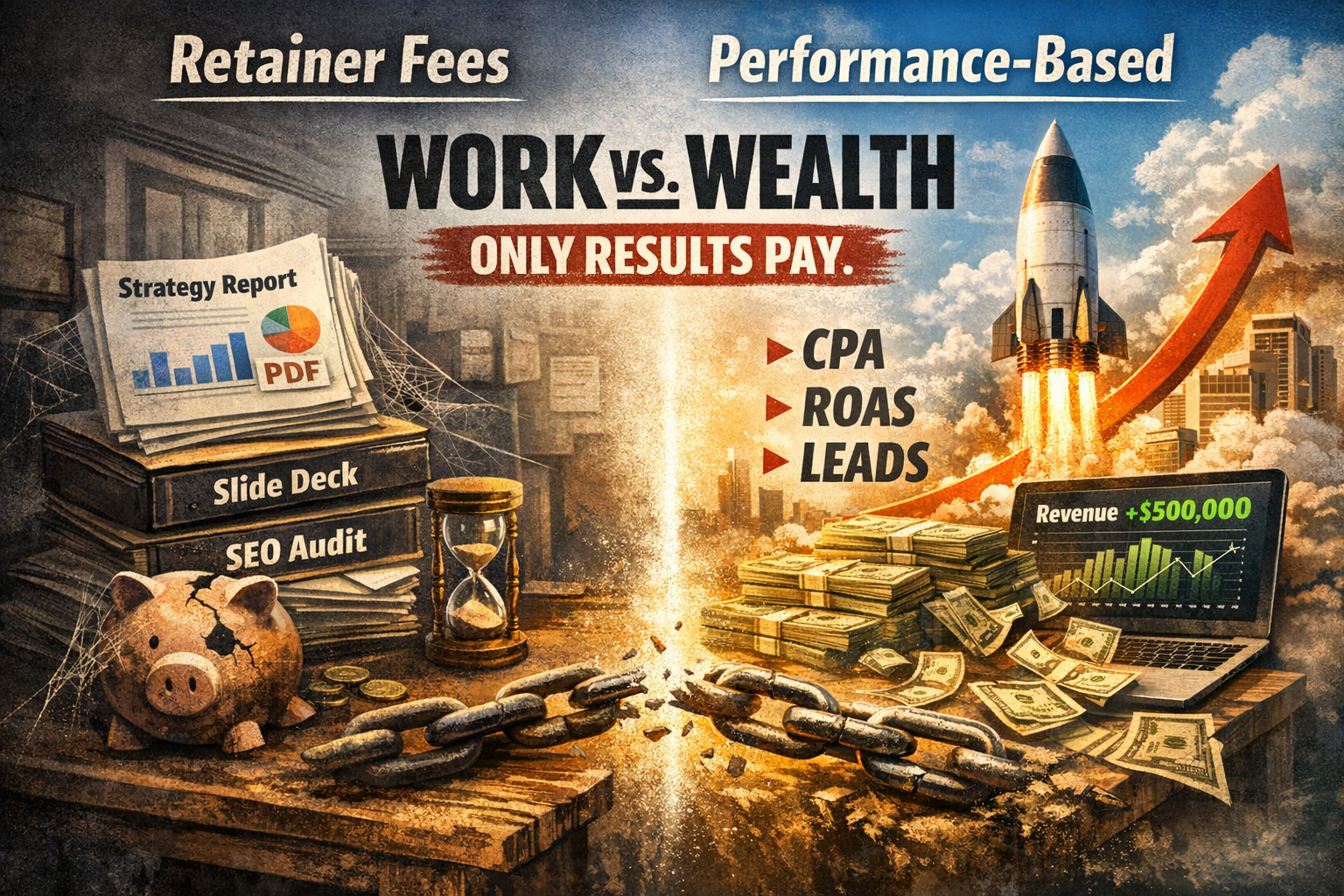
The $30,000 Slide Deck
Six months.
That’s how long the client waited.
They had hired a marketing agency on a $5,000/month retainer. The promise sounded reasonable: SEO strategy, content marketing, growth consulting. The usual language agencies use to signal sophistication.
Month one came with a 40-page strategy PDF.
Month two delivered a competitive analysis slide deck.
Month three included a “content roadmap.”
Month four? A revised roadmap.
Month five? A workshop.
Month six? A quarterly performance review.
Total cost: $30,000.
Total revenue generated from the campaign: $0.
Now, to be fair, the agency did deliver what they promised. The documents were well designed. The strategy decks were thoughtful. The meetings were polite.
But here’s the uncomfortable truth:
The client paid for work. Not wealth.
And that difference is exactly why the traditional agency retainer model is dying.
Not slowly.
Violently.
Retainers Are a False Security Blanket
The traditional agency retainer was invented for one reason:
Predictable revenue for the agency.
Not predictable growth for the client.
From the agency’s perspective, retainers are perfect. The money arrives on the first of every month. Payroll gets covered. The team stays busy.
But incentives shape behavior.
And under a retainer structure, the incentives are completely misaligned.
Let’s be honest about what happens inside most agencies:
If a client pays $5k/month, the agency must deliver just enough visible activity to justify that invoice.
Not maximum growth.
Just enough.
That activity usually looks like this:
- Reports
- Slide decks
- Keyword lists
- Content calendars
- Optimization checklists
None of these things are bad.
But they are proxies for progress, not progress itself.
It’s marketing theater.
And when clients start asking for actual outcomes—traffic growth, leads, revenue—that’s when the second problem appears.
The Scope Creep Trap
Fixed retainers create a silent war between agencies and clients.
It’s called scope creep.
Here’s how the conversation usually unfolds:
Client:
“Can you also optimize the landing pages?”
Agency:
“That’s outside the scope.”
Client:
“Can you help with conversion tracking?”
Agency:
“That’s not included.”
Client:
“Can you build the content that was in the strategy?”
Agency:
“That would require a new contract.”
Suddenly, the conversation shifts away from growth strategy and into task negotiation.
Every request becomes a billing discussion.
Every improvement becomes an upsell.
Both sides become defensive.
The agency protects its margins.
The client protects their budget.
And the one thing that should matter—Marketing ROI—gets buried under operational friction.
The result?
Marketing becomes a checklist instead of a growth engine.
The Only Metrics That Actually Matter
If marketing exists for one reason, it’s this:
To create economic value.
Not activity.
Not deliverables.
Value.
Which is why performance-based marketing focuses on three brutally simple metrics.
1. CPA (Cost Per Acquisition)
How much does it cost to acquire a customer?
If your CPA is $50 and your customer is worth $500, the math works.
If the CPA climbs above customer value, the system collapses.
Everything else—content, SEO, ads, automation—is just a lever to optimize this number.
2. ROAS (Return on Ad Spend)
For every dollar spent, how many dollars come back?
A 4x ROAS means $1 turns into $4.
It’s the cleanest measurement of marketing efficiency.
And it doesn’t care about your slide decks.
3. Qualified Lead Volume
Traffic is vanity.
Leads are currency.
But not just any leads—qualified leads.
People who actually have the budget, need, and intent to buy.
Growth happens when this number compounds.
Not when your keyword list grows from 200 terms to 1,000.
The Uncapped Upside Principle
Here’s the uncomfortable question most clients never ask agencies:
Why should marketing costs stay fixed if results explode?
Imagine this scenario.
Your marketing partner helps you generate $2 million in new revenue.
Would you really complain about paying them $200k?
Of course not.
Because value creation changes the equation.
Performance-based models unlock something retainers can’t:
uncapped upside.
When the agency wins only if the client wins, something magical happens.
They stop protecting scope.
They start chasing outcomes.
New channels get tested faster.
Conversion problems get solved aggressively.
Content strategies get built for scale.
Because now both sides are rowing in the same direction.
Growth.
A Pattern Interrupt
Let’s pause for a second.
If any of this sounds familiar—reports without revenue, strategy without execution—you’re not alone.
Most companies aren’t suffering from bad marketing.
They’re suffering from bad incentives.
Tired of paying for “activity” instead of outcomes?
See how our SEO performance model works.
The Newsletter Example (And Why It’s Absurd)
Let’s look at one of the most common marketing retainers: newsletter management.
Typical agency pricing:
$2,000/month to manage your newsletter.
Sounds reasonable.
But what exactly are you paying for?
Usually something like this:
- 4 email sends per month
- Newsletter design
- Copywriting
- List segmentation
- Reporting
Notice the pattern?
You’re paying for send frequency.
Not results.
Whether the newsletter generates 10 subscribers or 10,000… the agency gets paid exactly the same.
Which raises a question:
Why not pay for the thing that actually matters?
Verified subscriber growth.
Imagine a different structure:
Instead of paying $2k/month for four emails…
You pay $3 per verified subscriber added to your list.
Now the incentives flip instantly.
The agency suddenly cares about:
- Distribution strategy
- Viral loops
- SEO traffic funnels
- Lead magnets that convert
- Partnerships and list swaps
Because every new subscriber creates value for both sides.
This is what a scalable content strategy actually looks like.
Growth aligned with incentives.
The Hybrid Reality
Now let’s be brutally honest for a moment.
Pure performance-based billing sounds great.
But in reality, it’s rare.
And there’s a reason.
Some clients have:
- Weak products
- Broken funnels
- Bad unit economics
- Markets with no demand
No performance model can fix a fundamentally broken business.
Which is why smart alternative marketing agencies don’t run pure performance contracts.
We run something better.
The Floor + Ceiling Model
We call it the Floor + Ceiling model.
It balances accountability with operational reality.
Here’s how it works.
The Floor (Base Fee)
A modest base retainer covers essential overhead:
- Strategy infrastructure
- Tooling and analytics
- Core content production
- Technical SEO implementation
Think of it as the engine maintenance.
It keeps the system running.
The Ceiling (Performance Tier)
Then comes the upside.
Performance bonuses tied to:
- Qualified lead growth
- Revenue attribution
- Subscriber acquisition
- Pipeline expansion
Now the agency has a reason to push harder.
Because the more the client grows, the more the agency earns.
The incentives finally align.
And when incentives align, growth accelerates.
Why the Retainer Era Is Ending
The internet changed the rules of marketing.
Everything is measurable.
Everything is trackable.
Everything is attributable.
Which means the old model—paying agencies for time and activity—no longer makes sense.
Founders don’t want marketing reports.
They want predictable growth engines.
They want systems where:
- SEO compounds traffic
- Content compounds authority
- Distribution compounds audience
And the only honest pricing model for that kind of work is one where the agency shares the risk.
Because when we put skin in the game, two things happen.
Bad agencies disappear.
Good agencies become partners.
Not vendors.
The Hard Truth Most Agencies Won’t Say
Most agencies don’t offer performance pricing for one reason:
They can’t control the outcome.
Either their strategies don’t scale…
Or their systems aren’t predictable.
Performance models force a level of accountability that most agencies simply aren’t built for.
But when the model works, it changes everything.
Clients stop asking:
“Why are we paying you?”
And start asking:
“How fast can we scale this?”
That’s the difference between marketing as an expense…
…and marketing as an investment engine.
The Hard Closer
Here’s our philosophy.
We don’t want to get paid for activity.
We want to get paid for growth.
Because if we can’t generate measurable Marketing ROI, we shouldn’t be your agency.
Simple as that.
We don’t want your money if we can’t make you more.
Apply for a performance-based marketing audit and we’ll show you exactly where your growth engine is leaking—and how to fix it.
Leave a Reply