There’s a quiet tax in modern marketing.
No government collects it.
No accountant reports it.
But every small business owner pays it.
I call it the SaaS Tax.
You’ve probably seen it before.
A founder signs up for Semrush. Then Ahrefs. Maybe Surfer, Jasper, Canva Pro, and an analytics tool that promises “AI insights.”
The monthly bill creeps past $1,200.
But here’s the uncomfortable truth:
Most of those tools sit unopened.
Not because the tools are bad.
But because the founder doesn’t have time to become a full-time marketer.
And that’s the real tragedy of the SaaS Tax.
You’re paying enterprise prices for software you don’t have the hours—or expertise—to actually use.
Meanwhile, something strange is happening in the market.
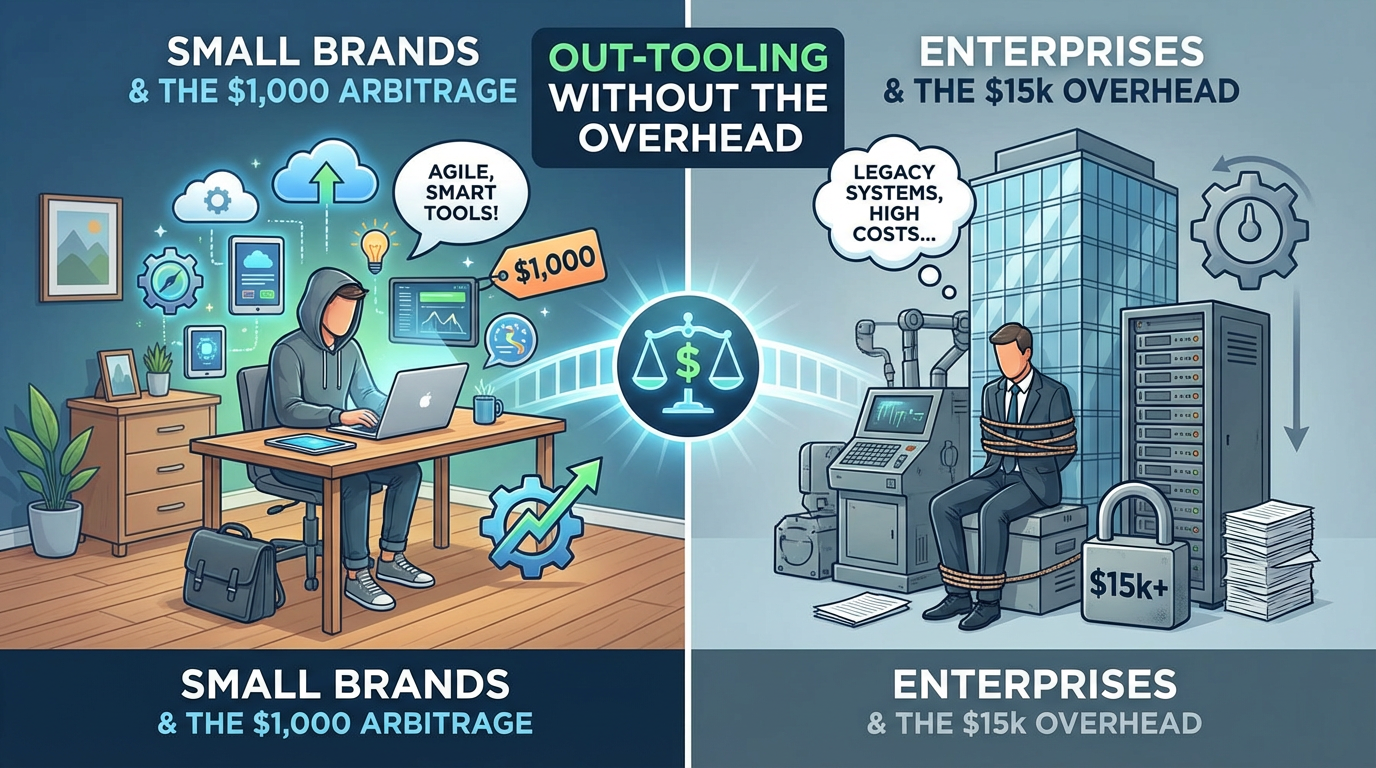
Small brands are quietly out-tooling enterprises.
Not by spending more.
By spending smarter.
The Overwhelmed Founder
Let’s talk about a shadow persona I see every week.
We’ll call her Maya.
Maya runs a growing e-commerce brand. Her product is solid. Customers love it. But growth has stalled.
So she does what every ambitious founder does:
She builds a marketing stack.
Her subscriptions look something like this:
- Semrush — $139/month
- Ahrefs — $129/month
- Surfer SEO — $89/month
- Canva Pro — $15/month
- Jasper AI — $59/month
- Google Ads tools + analytics add-ons — $100+
Total?
Roughly $532/month.
And that’s just the beginning.
Because tools don’t run themselves.
They demand time, expertise, and interpretation.
So Maya logs into Semrush once a week, stares at a graph, and wonders:
What exactly am I supposed to do with this?
She’s paying for an Enterprise SEO Stack.
But she’s operating it like a dashboard with blinking lights.
The Reveal: The $1,000 Enterprise Stack
Here’s the secret most small businesses don’t realize.
You don’t need access to enterprise tools.
You need someone who already lives inside them.
Because when you combine the right stack with the right operator, something powerful happens:
You unlock $15k worth of marketing intelligence for about $1,000/month.
That’s the arbitrage.
Instead of buying five random tools and hoping they connect…
You access a fully integrated marketing stack used the way enterprise teams actually use it.
Not as software.
As decision engines.
Let’s break down what that stack actually looks like.
Pillar 1: Search & AI Visibility
SEO used to be simple.
Find keywords.
Write articles.
Wait for rankings.
That world is gone.
Search has fractured into multiple layers:
- Google search results
- AI-generated answers
- Brand mentions in AI models
- Competitive SERP shifts
Modern SEO isn’t about keywords.
It’s about AI Visibility Tracking.
We track things like:
- Brand mentions in AI results
- Competitor topic ownership
- SERP volatility signals
- Emerging keyword clusters
Tools like Semrush, Ahrefs, and AI visibility trackers make this possible.
But the value isn’t the data.
It’s answering the only question that matters:
What should we do next week to gain visibility?
Software shows you numbers.
Strategy tells you where the opportunity actually lives.
Pillar 2: Content Strategy & Optimization
Here’s the uncomfortable truth about most DIY content marketing:
It’s guesswork dressed up as productivity.
A founder opens ChatGPT.
Writes an article.
Publishes it.
Then hopes Google notices.
Professional content strategy works differently.
We build topic ecosystems, not isolated posts.
That means every piece of content is part of a larger structure:
- Pillar pages
- Cluster articles
- SERP competitor analysis
- Real-time optimization scoring
Tools like Surfer or similar grading engines analyze content against the top-ranking pages in real time.
Not after publishing.
Before.
The difference is massive.
Instead of guessing whether content might rank…
You know if it already competes with the top 10 results.
This is how content marketing actually produces predictable ROI.
Quick Reality Check
If you’re currently paying for a Semrush seat you barely use, you’re not alone.
Most founders buy the tool.
Very few extract its real value.
If you’re tired of paying for a Semrush seat you never use, let’s talk.
Because the real win isn’t owning the tool.
It’s knowing what the data means.
Pillar 3: Intelligence & Reporting
Data without interpretation is just noise.
And marketing tools produce a lot of noise.
Dashboards.
Charts.
Keyword lists.
Traffic graphs.
But the real value of an Enterprise SEO Stack isn’t reporting.
It’s decision clarity.
Every week we ask:
- Which competitors are gaining authority?
- Which content topics are expanding in search demand?
- Where are rankings moving—and why?
Then we answer the “So what?”
For example:
A report might show:
“Keyword X moved from position 18 to 11.”
Nice.
But strategy asks:
“Is this keyword part of a larger cluster worth dominating?”
Because if it is…
That single ranking shift becomes a full content expansion opportunity.
This is the difference between data monitoring and marketing intelligence.
Pillar 4: Design & Distribution
Even brilliant content dies without presentation.
And this is where small brands quietly lose ground to enterprise teams.
Enterprises have:
- Designers
- Editors
- Distribution workflows
Founders have:
- Canva
- A coffee
- And 15 open tabs
Design tools like Canva Pro have democratized branding. But software still needs a system.
Professional distribution means:
- Visual assets that match platform algorithms
- Repurposed content across channels
- Consistent publishing cadence
- Audience capture mechanisms
Because traffic without conversion is just expensive attention.
Professional marketing closes that loop.
The Math of Sanity
Let’s go back to Maya.
Her DIY stack costs roughly $332–$532/month depending on which tools she uses.
But look at what that stack actually covers:
| Category | DIY Tools | Coverage |
| Keyword Research | Semrush/Ahrefs | Partial |
| Content Optimization | Surfer | Partial |
| Design | Canva | Basic |
| Analytics | Google tools | Raw data |
| Strategy | — | Missing |
What’s missing?
The operator.
The person who turns software into growth decisions.
Now compare that with a $1,000/month alternative marketing agency.
You get:
- Enterprise SEO tools
- AI visibility tracking
- Competitive intelligence
- Content strategy
- Optimization workflows
- Reporting interpretation
- Design and distribution support
And most importantly:
A team that already knows how to run the stack.
The founder stops learning software…
And starts getting marketing outcomes.
Why This Arbitrage Exists
Large companies don’t buy tools.
They buy teams around tools.
A typical enterprise marketing stack might look like this:
- $4k/month in SEO tools
- $6k/month in analytics software
- $5k/month in reporting platforms
Total software cost:
$15k+ per month.
But the real expense?
The team of specialists running it.
Small brands can’t replicate that internally.
But they can access it through shared infrastructure.
That’s the arbitrage.
One agency stack.
Multiple brands benefiting from it.
Enterprise capability.
Fractional cost.
The Real Problem Isn’t Tools
Let’s be honest.
The marketing world has a software addiction.
Every new tool promises:
- better insights
- smarter automation
- faster growth
But the bottleneck was never software.
It was interpretation.
The founders who win in 2026 aren’t the ones with the biggest stack.
They’re the ones who ask a better question:
Who actually knows how to turn this data into growth?
That’s why more small brands are abandoning the DIY stack.
Not because tools are bad.
But because time is expensive.
The No-Brainer Shift
The Overwhelmed Founder eventually realizes something.
She didn’t start her company to become a part-time SEO analyst.
She started it to build a great product and a thriving business.
And when she finally runs the numbers…
The answer becomes obvious.
Instead of spending hundreds on software and thousands of hours figuring it out…
She buys the one thing that actually matters:
Results.
Stop buying tools.
Start buying outcomes.
Stop buying tools. Start buying results.
Book a Strategy Audit @alternativemarketing.agency
Leave a Reply