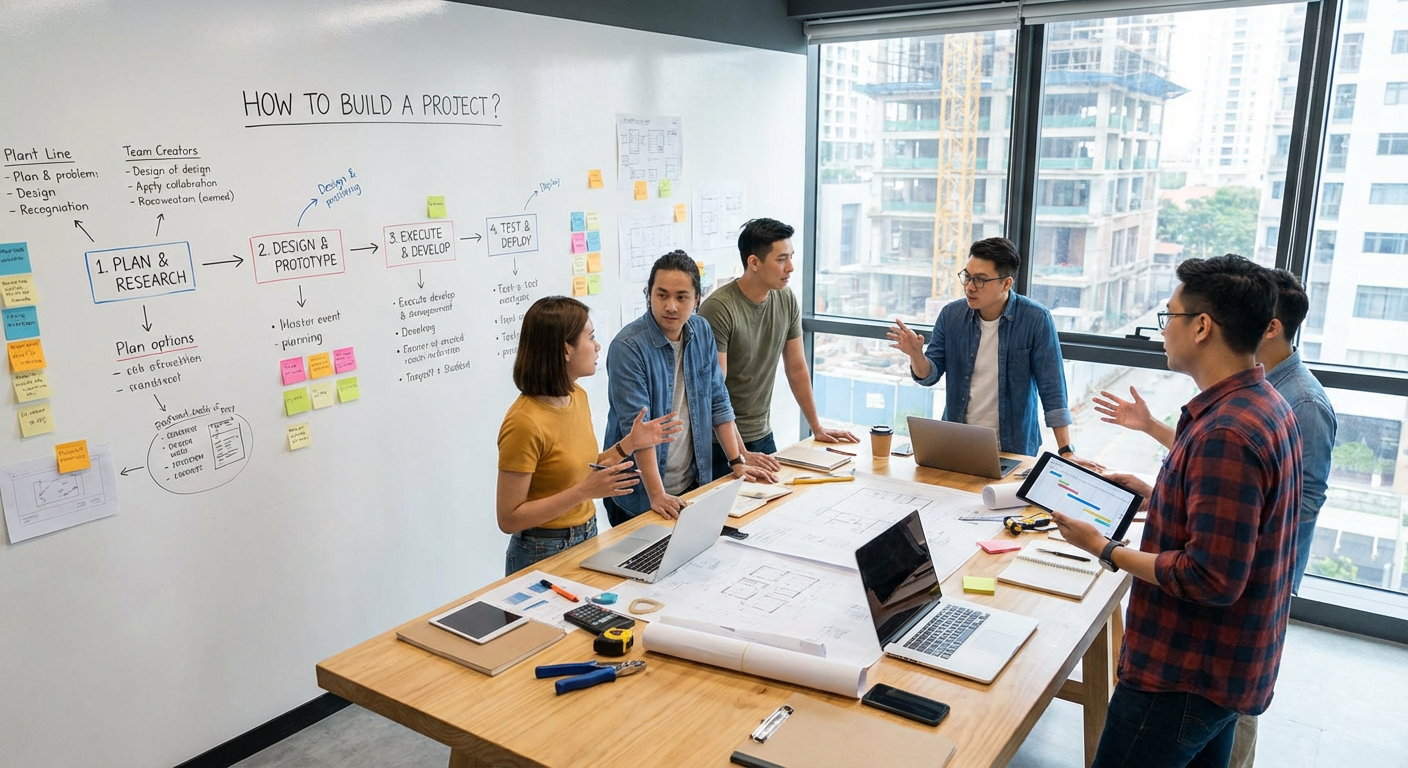
What is the best strategy to build a project with maximum efficiency without sacrificing quality?
Everything is a project, building a bridge is a project, building a skyscraper is a project, building a humanoid robot is a project, losing weight is a project, even writing this article is a project.
Many projects we start with ultimate enthusiasm and passion and forget about it the next day, or we procrastinate and never start, or we get distracted at the middle of the road, or we deviate when we think we’ve reached the top of the success mountain.
Thus I claim, knowing how to build a project is the ultimate skill a human being can learn.
So how to build a project?
Projects’ Elements
Any project consists of specific elements, the team, the complexity, the plan, the resources, the timeline, the goal, the feedback system, and so on.
When these elements work together synchronously it produces success and great results and attracts a growing audience. The challenge then for you as a project owner/manager/leader is to get these parts together in the correct way.
That is not an easy task, that’s why so many projects fail.
It requires a balance between depth of knowledge of each element and breadth of knowledge of all the other elements and knowledge of the environment where this project will operate in and the synchronisation ability to get all these different parts working together in a correct order.
The Limited Resources
Resources are not infinite, that’s what you discover when you start working on a real project. Mistakes consume resources, lack of focus wastes resources, not having a plan pleads resources,
And suddenly you discover that you are in a highway in a car with an empty tank, you’re stuck, and if your phone battery has died at the exact same moment God only knows for how much time you’re gonna spend in the middle of nowhere.
The Leader
The leader has only one main mission, in my opinion, which is: setting the direction.
In which direction are we going to move?
That’s not an easy question.
Many people have skills, but they don’t know what to do with it.
What to build? What to draw? What to cook?
When you’re drawn into the details and mechanics of your profession you forget about the outer world, so you lack the inspiration, and you don’t understand the pains its going through that you could solve if you knew about it.
Many people shy away from leadership positions, and many others fight for it when they are not qualified.
The characteristics of a great leader is an endless debate, a leadership style that works for a specific set of circumstances fails in a different one, and what works for a certain group might not necessarily work for the other.
But you know a great leader when you meet him, the vibes, the dream, the passion, the promise, the consistency.
The Team
If you have a great team you have cut 80% of the hassle you need to build a successful project.
A team who understands the ultimate mission, and his specific role in it, and how to coordinate with other members and departments of the project, and what is the impact of the decision he makes on the overall performance of the project. If you have that then that is the dream and you won’t have to work as a manager/leader.
But it’s the real world, and in the real world mistakes happen, misunderstanding leads to wasted effort, lack of communication leads to isolated or even competing departments.
The real world is messy, complex, and chaotic.
And the chaos only increases with time.
No “One-Size-Fits-All” Solutions
You might notice that I am stating the problems and challenges but suggesting no solutions.
That happens because of two things:
- Each one of those challenges needs an article, or even a book to discuss solutions for it
- No situation is exactly the same like the other, so no single technique fits as a solution for all the problems you’re going to face.
But instead of “Step-by-step” guides I intended to talk about principles more than talking about techniques.
Techniques get outdated once there’s a shift in the landscape, but principles are evergreen and fit every landscape.
So you need to learn how to think, not how to copy and paste.
Machines are great copy/pasters, to shine now you have to be an original operator of your machines and tools.
Leave a Reply