He didn’t panic at first.
When CAC ticked up 12%, he blamed seasonality.
When ROAS slipped from 4.2x to 2.9x, he blamed competition.
When Meta CPMs doubled and Google’s PMax started cannibalizing branded queries, he blamed the algorithm.
Then margins disappeared.
Not gradually. Suddenly.
Seven-figure revenue.
Zero profit.
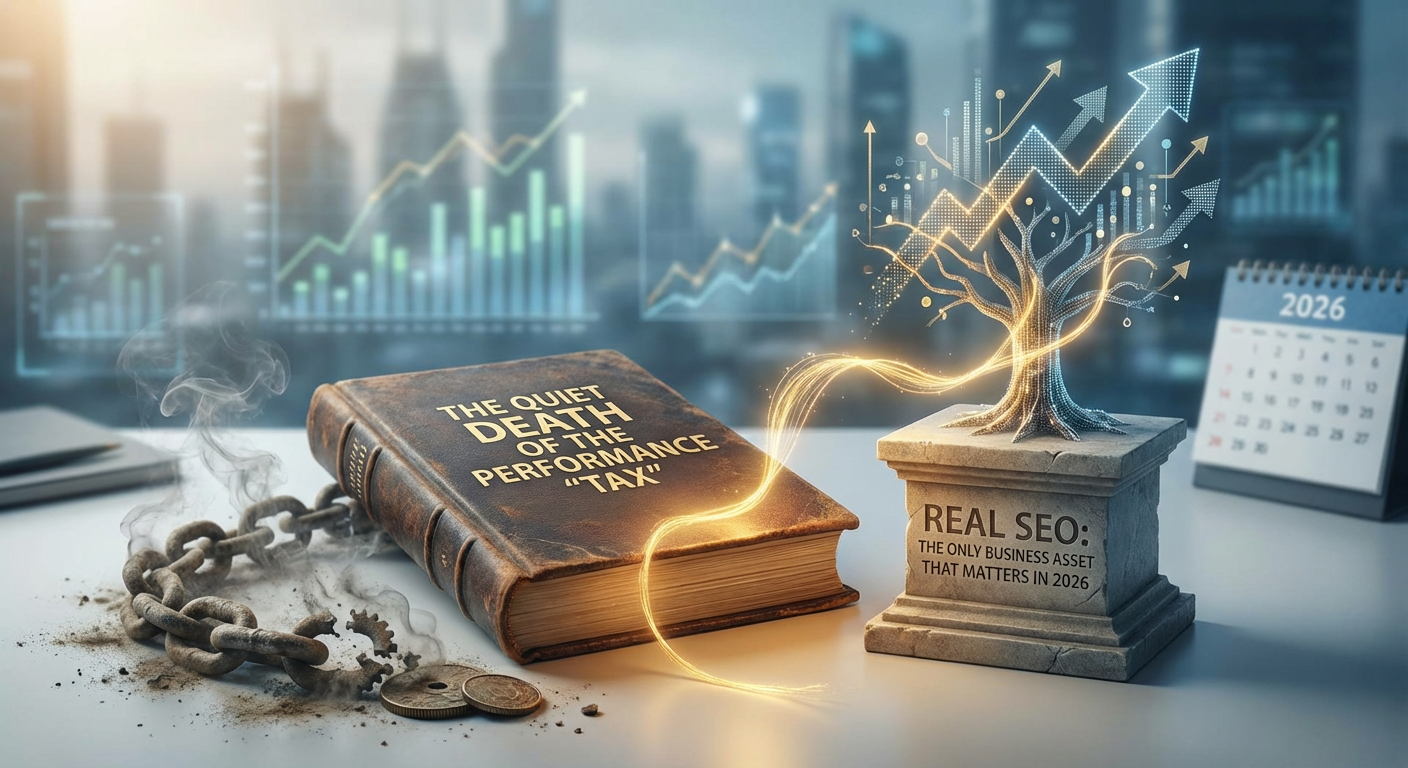
Welcome to the quiet death of the performance model.
For a decade, founders were told paid media was scale. Predictable. Measurable. Clean dashboards. Smooth graphs.
What they weren’t told? It’s a tax.
The Google/Meta Tax.
And in 2026, that tax is compounding.
The Hard Truth: Organic Revenue Isn’t “Free.” It’s High-Intent Equity.
Let’s kill the myth first.
Organic traffic is not “free traffic.”
It is high-intent lifetime value at acquisition cost zero.
When someone searches:
- “best commercial dishwasher for restaurant”
- “how to fix error code E15 Bosch”
- “enterprise SEO agency pricing”
They’re not browsing.
They’re solving.
Paid ads interrupt.
Organic search intercepts intent.
And interruption has a shelf life.
Ads are disruptive by design. They rent attention. The second you stop paying, traffic vanishes.
Organic conversion value works differently:
- Higher trust
- Lower bounce
- Higher LTV
- Lower refund rates
- More branded searches later
Because the buyer chose you.
That difference compounds quietly. And compounding always wins.
Hard truth: If 70% of your revenue depends on paid acquisition, you don’t have a growth strategy. You have a dependency.
📦 Key Takeaway
Paid ads generate transactions.
SEO generates equity.
Equity compounds. Transactions reset every month.
The Digital Landlord: Owning the House vs Renting the Traffic
Imagine two businesses.
Business A rents traffic.
Business B owns it.
Business A spends $60,000/month on PPC.
Business B invests $60,000/month into technical authority, strategic content, and search dominance.
After 18 months:
Business A has a dashboard.
Business B has digital real estate.
Here’s the difference:
When you rank:
- Your content earns traffic while you sleep.
- Your branded queries grow.
- Your domain authority compounds.
- Your acquisition cost declines over time.
That’s not marketing.
That’s asset accumulation.
The digital landlord model is simple:
Every optimized page is a property.
Every backlink is zoning approval.
Every technical fix is structural reinforcement.
Every topical cluster is neighborhood expansion.
Paid traffic is renting an apartment in someone else’s city.
SEO is building the city.
And here’s what no one tells founders:
When algorithm updates hit, rented traffic collapses first.
Owners survive.
Because search visibility isn’t just rankings. It’s authority depth.
📦 Key Takeaway
PPC is a lever.
SEO is infrastructure.
Levers move quickly. Infrastructure survives shocks.
The Invisible Edge: SEO as Market Intelligence
Most companies treat SEO like a checklist:
- Fix meta titles
- Add keywords
- Build links
That’s tactical SEO.
Real SEO is diagnostic.
Search data reveals:
- What your buyers fear
- What objections stop them
- What competitors are promising
- Where your UX leaks revenue
If users constantly search “Is [Your Brand] legit?” you have a trust problem.
If comparison queries dominate your niche, you have a positioning problem.
If your blog ranks but doesn’t convert, you have a narrative gap.
SEO is the most honest mirror your business will ever face.
Because it reflects real intent at scale.
It forces you to answer:
- Why should anyone trust you?
- Why are you better?
- Why now?
And when done correctly, it improves:
- UX clarity
- Conversion pathways
- Information architecture
- Brand messaging consistency
Technical SEO cleans crawl paths.
Strategic SEO cleans business blind spots.
That’s why the best-performing companies don’t “add SEO.”
They build around it.
The Safety Net: Algorithm Resilience and Brand Protection
Here’s the risk no one models.
Search your own brand.
If you don’t own:
- Position 1
- Position 2
- Position 3
You don’t control your reputation.
Competitors can bid on your brand.
Affiliates can outrank you.
Review sites can dominate the narrative.
If someone Googles your company and lands on a comparison page first, you’ve already lost leverage.
Brand SEO isn’t vanity.
It’s defense.
And beyond brand protection lies algorithm resilience.
Businesses built only on arbitrage (buy traffic cheap, sell higher) collapse when:
- CPMs spike
- Privacy rules tighten
- Platforms shift attribution models
Businesses built on search authority adapt.
Why?
Because they own topical depth.
When Google updates reward helpful content, they rise.
When thin affiliate sites disappear, they absorb the vacuum.
Authority insulates.
Dependency exposes.
📦 Key Takeaway
If your growth disappears when ad budgets pause, you don’t have growth.
You have rented visibility.
The Inverted Success Story
Let’s go back to that founder watching margins evaporate.
He didn’t pivot because SEO sounded trendy.
He pivoted because paid performance stopped being performance.
Year one of transition was uncomfortable.
Traffic dipped slightly as budgets rebalanced.
But they built:
- Technical architecture
- Topic clusters around buyer intent
- Product comparison pages that actually helped
- Brand SERP dominance
- Structured internal linking
By month 12:
Branded searches increased 41%.
By month 18:
Organic revenue surpassed paid revenue.
By month 24:
Paid ads became amplification—not survival.
That’s the inversion.
Paid stops being oxygen.
It becomes acceleration.
That’s where real leverage begins.
SEO in 2026: Risk Mitigation, Not Just Growth
In volatile markets, stability is alpha.
Real SEO provides:
- Revenue diversification
- Reduced CAC volatility
- Trust compounding
- Market intelligence loops
- Brand moat reinforcement
Most agencies still sell rankings.
That’s outdated.
Rankings without strategy are vanity metrics.
What matters is:
- Organic conversion value
- Brand query growth
- Share of search
- Authority against core buying keywords
If your traffic feels like a rental property you’re about to lose, let’s talk about building equity.
Because the performance tax isn’t shrinking.
It’s increasing.
The Alternative Approach
Traditional agencies optimize pages.
We build market resilience.
An Alternative Marketing framework doesn’t ask:
“How do we rank?”
It asks:
“How do we own the conversation?”
That means:
- Mapping commercial intent before content creation
- Building technical foundations that scale
- Engineering brand SERP control
- Turning blog traffic into demand capture
- Treating SEO as a balance sheet asset
Most agencies chase clicks.
We build authority.
If your board still sees SEO as “long-term traffic,” you’re measuring the wrong outcome.
It’s long-term control.
And control is margin.
The Economics No One Talks About
Let’s run the quiet math.
If your paid acquisition costs rise 20% annually (they often do), and you scale revenue 30%, your profit margin shrinks unless pricing increases.
If your organic acquisition cost declines as authority compounds, revenue growth expands margins.
One model compresses profit over time.
One expands it.
This is why some 7-figure businesses quietly implode after 3–4 “great” revenue years.
Revenue grew.
Equity didn’t.
And when platform conditions shifted, the house collapsed.
SEO, done properly, behaves like:
- Intellectual property
- Brand equity
- Distribution control
It is not a marketing channel.
It is a business asset.
The Final Reality
In 2026, attention is rented.
Authority is owned.
If you depend entirely on Google Ads or Meta to survive, you are building on leased land.
And landlords raise prices.
The companies thriving now aren’t louder.
They’re structurally stronger.
They dominate:
- Commercial intent keywords
- Comparison queries
- Informational buyer research
- Brand SERPs
They don’t fear algorithm updates.
They prepare for them.
They don’t chase traffic.
They architect it.
If you’re still treating SEO as a line item instead of an asset class, the market will eventually correct that mistake.
Usually painfully.
Most agencies optimize for the next report.
We optimize for the next five years.
If you want to see how our Alternative Marketing framework builds resilience instead of dependency, explore how we engineer authority—not just rankings.
Because the performance tax isn’t disappearing.
It’s just quietly draining the businesses that refuse to build equity.
And in 2026, equity is the only growth that survives.
Leave a Reply