1. The Moment the Plateau Hits
The CMO leaned back in her chair and stared at the dashboard.
Traffic had grown for 18 months straight. Then it stopped.
Not declined. Not crashed. Just… flat.
Her SEO team blamed competition. The CEO blamed Google. The board blamed marketing spend.
And someone eventually asked the question:
“Didn’t we build hundreds of backlinks last year?”
Silence.
Because the links were there.
The rankings were not.
This is the moment when most companies begin to confront a hard truth:
Backlinks alone are no longer an SEO strategy.
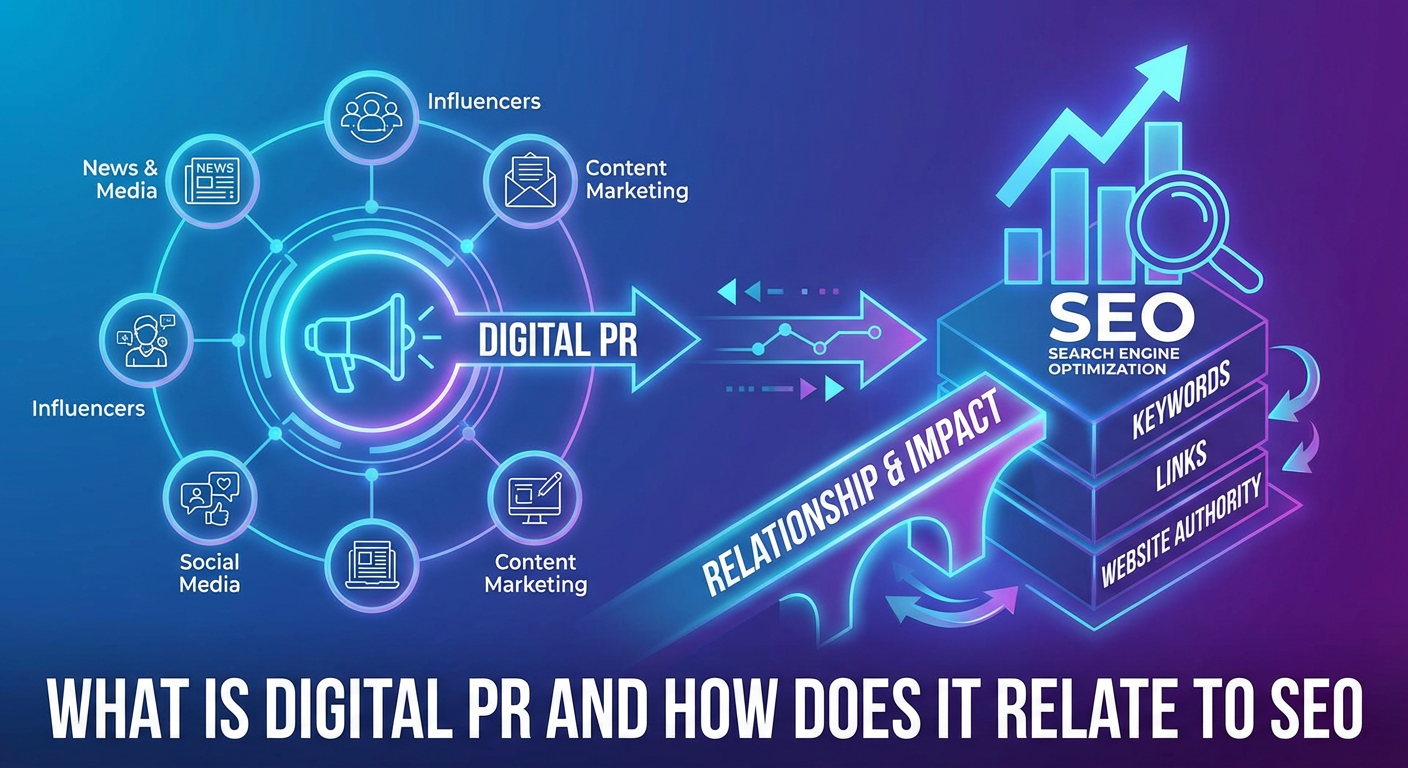
This is where Digital PR and SEO begin to intersect in a way that changes everything.
2. Moving Beyond the “Backlink” Mindset
For years, SEO authority was treated like a numbers game.
More links = more rankings.
Agencies sold packages.
Teams tracked Domain Rating.
Everyone celebrated volume.
Then Google evolved.
The Death of Transactional Link Building
Private blog networks.
Guest post farms.
Bulk outreach for low-tier placements.
They worked—until they didn’t.
The algorithm got smarter. More importantly, Google’s quality raters began emphasizing E-E-A-T (Experience, Expertise, Authoritativeness, Trustworthiness).
Authority stopped being about link quantity.
It became about credibility.
The shift wasn’t subtle.
Google now evaluates:
- Who is talking about you
- Where they’re talking about you
- Why they’re talking about you
- Whether real audiences care
This is not link building.
This is reputation engineering.
Why E-E-A-T Changed the Game
E-E-A-T is often misunderstood as a content checklist.
It isn’t.
It’s a trust validation system.
If credible publications cite your data, quote your executives, or reference your research, that becomes a measurable authority signal.
That’s where Digital PR becomes the modern authority engine.
Not because it “builds links.”
But because it builds legitimacy.
And legitimacy compounds.
If your SEO strategy is still operating in isolation from brand authority, you’re playing a shrinking game.
3. What Digital PR Actually Is (And What It Isn’t)
Let’s remove the confusion.
Traditional PR is about media relationships and reputation management.
Digital PR is about strategic authority acquisition in online environments.
They overlap—but they are not identical.
Traditional PR vs Digital PR
Traditional PR:
- Broadcast media
- Print publications
- Brand perception
- Awareness campaigns
Digital PR:
- Online publications
- Data-driven stories
- Link-earning narratives
- Search-aligned campaigns
Traditional PR measures impressions.
Digital PR measures authority transfer.
That difference is critical.
The Mechanics of a Real Digital PR Strategy
A proper Digital PR strategy is not “sending press releases.”
It typically includes:
1. Data-Led Storytelling
Original research.
Industry surveys.
Proprietary data.
Journalists don’t link to opinions.
They link to evidence.
When a SaaS company publishes benchmark data, that becomes a citation asset.
2. Newsjacking (Done Intelligently)
A regulatory update hits your industry.
A major tech platform changes policy.
An economic shift affects your market.
If your experts provide immediate, relevant commentary, journalists need you.
That coverage often results in earned media placements with high authority domains.
3. Expert Commentary and Thought Leadership
Executives positioned as subject-matter experts.
Quoted in:
- Industry publications
- High-authority news sites
- Trade media
These aren’t purchased links.
They’re earned references.
And the difference between earned and paid placements is enormous.
Earned Media vs Paid Placements
Paid placements transfer minimal trust.
Earned media transfers credibility.
Search engines can distinguish patterns.
So can audiences.
If your brand is cited organically in reputable publications, that becomes a durable SEO authority signal.
This is the strategic bridge between Digital PR and SEO.
4. The Direct Impact of Digital PR on SEO
Let’s break this down logically.
1. High-Quality Backlinks (Not Manufactured Ones)
There is a difference between:
- A contextual link from a respected industry publication
- A sidebar link on a recycled blog network
The first passes authority because it reflects editorial validation.
The second passes risk.
When people debate “Backlinks vs PR,” they miss the point.
Digital PR produces backlinks—but as a byproduct of authority.
That distinction matters.
2. Referral Traffic That Converts
Links from real publications drive real users.
These users:
- Spend time on site
- Explore multiple pages
- Convert at higher rates
Why?
Because trust was pre-transferred.
Traffic from a respected industry source behaves differently than traffic from a link farm.
Google notices behavioral signals.
3. Brand Mentions (Linked and Unlinked)
Search engines increasingly understand brand signals beyond hyperlinks.
Unlinked mentions across authoritative domains reinforce relevance and visibility.
Brand signals influence:
- Entity recognition
- Topical authority
- Semantic relevance
This is where Digital PR and SEO quietly reinforce each other.
4. Authority Signal Consolidation
When coverage accumulates across reputable domains, a pattern forms.
Google doesn’t see isolated links.
It sees a network of validation.
That network contributes directly to SEO authority.
This is typically the point where in-house teams hit a wall.
They can optimize pages.
They can build content hubs.
But they cannot manufacture credibility.
Authority must be earned.
5. The Indirect (But Crucial) SEO Benefits
The direct benefits are measurable.
The indirect benefits are transformative.
Brand Search Volume Increases
After consistent earned media coverage:
- More people search your brand
- More branded queries appear
- More navigational traffic flows
Brand search volume is one of the strongest signals of legitimacy.
It tells Google:
“This company matters.”
SEO without brand demand is fragile.
Digital PR fuels demand.
E-E-A-T Validation at Scale
Imagine two competitors:
Company A:
- Optimized content
- Technical SEO clean
- Few brand citations
Company B:
- Optimized content
- Technical SEO clean
- Quoted in multiple respected publications
Who appears more trustworthy?
E-E-A-T is not theoretical.
It’s comparative.
And Digital PR accelerates trust validation.
Content Synergy
When Digital PR campaigns are aligned with SEO research:
- Target keywords inform campaign themes
- PR assets support high-value content clusters
- Authority flows into strategic landing pages
This is where integration matters.
SEO finds demand.
Content builds depth.
Digital PR builds authority.
Separately, they help.
Together, they compound.
If you’re serious about building authority instead of just traffic, integration becomes non-negotiable.
Trust Acceleration
Organic growth normally takes time.
Digital PR compresses the trust curve.
Instead of waiting years to be recognized, strategic earned media creates immediate legitimacy signals.
That legitimacy influences:
- Sales conversations
- Investor perception
- Talent acquisition
- Partnership opportunities
SEO rarely operates in isolation from business outcomes.
Neither should your authority strategy.
6. The Brutal Reality: Where PR Fails SEO
Let’s be honest.
Digital PR is powerful.
It is not magic.
No-Follow Links
Many major publications use no-follow attributes.
Do they still matter?
Yes—indirectly.
They contribute to brand visibility and signals.
But if your entire strategy relies on no-follow coverage, you will not see full SEO authority transfer.
Balance matters.
Attribution Challenges
PR teams often measure impressions.
SEO teams measure rankings.
If campaigns aren’t aligned, impact becomes invisible.
Authority builds gradually.
But without shared KPIs, Digital PR can look disconnected from performance.
This is a strategic failure—not a channel failure.
PR Cannot Fix Technical SEO
If your site:
- Has crawl issues
- Suffers from poor architecture
- Loads slowly
- Contains thin content
No amount of earned media will save rankings.
Authority amplifies what exists.
If the foundation is broken, amplification accelerates failure.
This is why PR alone cannot fix SEO.
And SEO alone cannot build authority.
7. The Unified Growth Engine
Here is the part most companies miss.
SEO, content, and Digital PR are not channels.
They are components of one system.
Step 1: SEO Identifies Demand
Keyword research surfaces:
- High-intent queries
- Information gaps
- Competitive weaknesses
This informs where authority is needed most.
Step 2: Content Builds Depth
Strategic content clusters establish:
- Topical relevance
- Internal linking architecture
- Conversion pathways
But depth without authority struggles to rank.
Step 3: Digital PR Builds Authority
Campaigns are designed to:
- Earn coverage aligned with core themes
- Support priority keyword clusters
- Transfer authority to strategic pages
This creates compounding growth.
Rankings improve.
Brand search increases.
Media interest grows.
Authority builds further.
It becomes a flywheel.
This is where Digital PR and SEO stop being separate tactics and become a unified growth strategy.
8. Why Most Companies Get This Wrong
They silo teams.
PR reports to communications.
SEO reports to marketing.
Content sits somewhere in between.
No shared roadmap.
No authority map.
No integrated strategy.
So:
PR wins awards.
SEO fights for backlinks.
Content produces volume.
But growth stalls.
This is typically the point where companies bring in strategic partners—not for execution, but for alignment.
Because integration is not a task.
It’s an architectural decision.
9. Rethinking Your Authority Strategy
If your SEO growth has plateaued, ask:
- Are we building authority—or just optimizing pages?
- Are our PR efforts aligned with search demand?
- Do our earned media placements reinforce priority keywords?
- Is our brand being cited where it matters?
If not, the issue isn’t effort.
It’s structure.
The companies that win in competitive markets understand that authority is engineered deliberately.
Not accidentally.
Not transactionally.
Strategically.
Final Thought: Authority Is the New Moat
Traffic can be copied.
Content can be replicated.
Technical SEO can be reverse-engineered.
Authority cannot.
It must be earned.
And when Digital PR and SEO operate together, authority compounds into a durable competitive advantage.
If you’re evaluating your next phase of growth, this is the moment to audit your authority strategy—not just your rankings.
Rethink your SEO roadmap.
And consider whether your Digital PR strategy is reinforcing your search objectives—or operating in isolation.
Because in modern search, visibility follows credibility.
And credibility is built, not bought.
Leave a Reply