The Efficiency Trap Starts Quietly
The room is glass. Twelve floors up. Cairo skyline bleeding through the blinds.
The CMO doesn’t look angry. That’s worse.
He slides a report across the table. “Traffic is up 63%,” he says. Pause. “Revenue is down 18%.”
No one speaks.
The dashboard is immaculate—clean charts, perfect attribution models, keyword clusters mapped to intent like a textbook case study. The agency did everything right. Technically flawless. Blazing-fast site speed. Semantic SEO coverage so complete it could suffocate a niche.
And yet—negative ROI.
Because the strategy was… obvious.
Every move was justified. Data-backed. Promptable.
Which is the problem.
AI didn’t kill this campaign. It perfected it—into irrelevance.
Because when every decision is probability-based, you converge toward the mean. And the mean doesn’t win markets. It preserves them… until someone irrational shows up.
This is the quiet death of modern marketing: optimization without conviction.
If a strategy can be prompted, it’s already a commodity.
What isn’t? The moves that look wrong—until they aren’t.
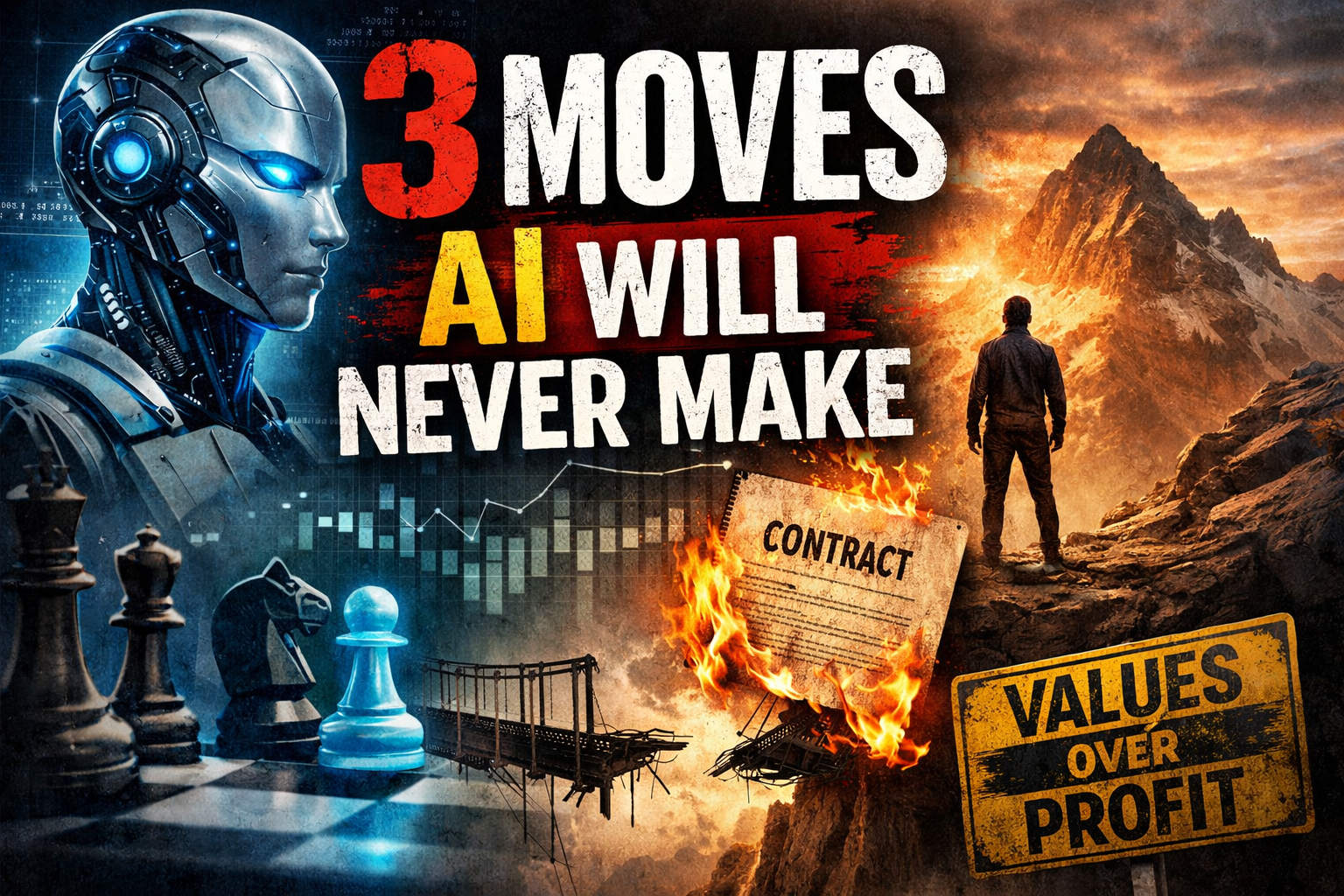
Move #1: The Logic Break — AI Is Pathologically Average
AI doesn’t think. It aggregates.
It is the statistical center of everything that has already worked. Which means it’s incapable of inventing something that shouldn’t work.
And that’s exactly where the edge lives.
The best-performing campaigns I’ve seen in the last decade all had one thing in common: they made no sense on paper.
A fintech brand deliberately tanked its own conversion rate.
Yes—on purpose.
They replaced their polished landing page with a blunt, almost confrontational message: “If you’re looking for quick money, leave. This isn’t for you.”
Every optimization instinct screamed against it. Bounce rates spiked. CAC initially worsened.
Then something strange happened.
LTV doubled.
Why? Because they filtered out the wrong customers upfront. They broke the logic of “maximize conversions” and instead optimized for who should never convert.
AI won’t suggest that. It can’t. It’s trained on success patterns, not strategic rebellion.
This is the essence of Alternative Marketing: doing what doesn’t scale immediately to build something that compounds brutally over time.
At our agency, this is where most engagements begin—not with keyword research, but with a question that makes clients uncomfortable:
“What if the data is pointing you in the wrong direction?”
Because sometimes, it is.
And if your strategy feels “safe,” it’s probably already priced into the market.
The Hidden Cost of Being Right
Here’s the uncomfortable truth: you can be 100% correct—and still lose.
You can follow best practices, hit every SEO benchmark, maintain a pristine LTV:CAC ratio on paper—and still end up invisible.
Why?
Because you’re competing in the same lane as everyone else who read the same playbook.
AI accelerates this convergence. It doesn’t differentiate you—it standardizes you.
This is why SERP volatility isn’t just a technical problem. It’s a strategic one.
If your entire growth engine depends on predictable ranking factors, you’re building on rented land.
The brands that survive don’t just rank. They redirect attention.
And that requires something AI fundamentally lacks: the willingness to be wrong in public.
If you’re tired of “safe” SEO that yields average results, this is where the conversation shifts—from optimization to conviction.
Move #2: The Reputation Bridge — “One Throat to Choke”
There’s a phrase clients won’t say out loud, but they think it:
“If this fails, who do I blame?”
It’s crude. It’s real.
And it’s why AI will never replace agencies—not the ones that matter.
Because clients don’t just buy output. They buy accountability.
They want one throat to choke.
AI has no downside. No career risk. No reputation at stake. It doesn’t wake up at 3 AM wondering if a campaign will implode and take a client relationship with it.
You do.
That asymmetry is your edge.
SEO Without Accountability Is Just Noise
We’ve entered an era where anyone can generate 100,000 words of “optimized” content in a weekend.
The result? A flood of indistinguishable assets chasing the same keywords.
What’s missing is ownership.
Who stands behind the strategy when rankings drop? When conversion rates collapse? When Google updates wipe out half your traffic overnight?
AI won’t take that call.
At our agency, SEO accountability isn’t a buzzword. It’s operational.
We don’t just deliver content—we attach our name to outcomes. That changes how you think.
You stop chasing vanity metrics. You start making decisions that protect long-term revenue, even if they hurt short-term optics.
That’s why human-anchored strategy matters.
Because when there’s skin in the game, you don’t optimize for what looks good—you optimize for what survives.
The Real Product Isn’t Content—It’s Judgment
Clients often think they’re buying execution.
They’re not.
They’re buying judgment under uncertainty.
Anyone can prompt an AI to generate a content calendar. Few can decide which ideas should never be published.
That’s where reputations are built—or destroyed.
We’ve turned down campaigns that would have generated traffic but diluted brand positioning. We’ve killed content pipelines mid-stream because the signal wasn’t translating into revenue.
Those aren’t popular decisions.
They’re necessary ones.
If your current strategy doesn’t have a human willing to say “no,” it doesn’t have a strategy. It has a content machine.
And content machines don’t win—they flood.
Move #3: The Moral Pivot — The Power of Walking Away
This is where it gets uncomfortable.
Because the highest-leverage move you can make isn’t tactical. It’s ethical.
Firing a client.
Not because they’re unprofitable—but because they don’t align.
It sounds irrational. It often is.
And it works.
The Day We Walked Away from Easy Money
A few years ago, we had a client with a perfect profile: high spend, fast approvals, aggressive growth targets.
On paper, a dream.
In reality, a mismatch.
Their product wasn’t bad—but their messaging relied on exaggeration. Not outright deception, but close enough to blur the line.
We flagged it. They pushed back.
The revenue was tempting. The pipeline was strong. Walking away meant a short-term hit to cash flow and utilization rates.
We did it anyway.
No grand announcement. No virtue signaling. Just a clean exit.
For three months, it hurt.
Then something shifted.
Our positioning sharpened. Referrals improved. The clients who came in afterward weren’t just better fits—they were aligned.
Higher retention. Better LTV. Less friction.
That single decision did more for our brand equity than any campaign we could have run.
Values-Based De-Positioning Creates Gravity
When you say “no” to the wrong clients, you create space for the right ones.
More importantly, you signal something rare: conviction.
In a market flooded with interchangeable agencies, conviction is magnetic.
AI can’t make that call.
It doesn’t have values. It doesn’t experience regret. It doesn’t understand the long-term compounding effect of reputation.
It will always choose the statistically optimal path—even if that path erodes trust over time.
Humans can choose differently.
That’s the moral pivot.
And it’s one of the few strategic moves that still creates asymmetric returns.
At our agency, this isn’t theory. It’s policy. We’d rather take a short-term revenue hit than build technical debt into our reputation.
Because reputational debt compounds faster—and kills slower.
The Illusion of Scale vs. The Reality of Leverage
AI gives you scale.
But scale without direction is just amplification.
You don’t need more content. You need better bets.
And better bets come from decisions that don’t make sense until they do:
- Saying no to easy traffic
- Owning outcomes instead of outputs
- Walking away from profitable misalignment
These aren’t optimizations. They’re commitments.
And they’re precisely the moves AI will never make.
The New Agency Directive: Choose the Mountain
AI is the engine.
It’s powerful, efficient, relentless.
But engines don’t choose destinations.
They don’t decide which mountain is worth climbing—or whether the climb is worth it at all.
That’s your job.
The agencies that win in this next era won’t be the ones with the best prompts. They’ll be the ones with the strongest point of view.
They’ll use AI aggressively—but not blindly.
They’ll optimize where it makes sense—and break logic where it doesn’t.
They’ll attach their reputation to outcomes—and walk away when those outcomes compromise their values.
In short: they’ll act like humans.
A Final Question Worth Sitting With
If your entire strategy could be replicated by someone with a better prompt…
What exactly are you being paid for?
If that question stings, good.
That’s where the real work starts.
And if you’re ready to move beyond “efficient” marketing into something that actually builds leverage—this is the kind of high-friction, conviction-led strategy we build every day.
Not for everyone.
But for the ones who are tired of winning on paper—and losing where it counts.
Leave a Reply